



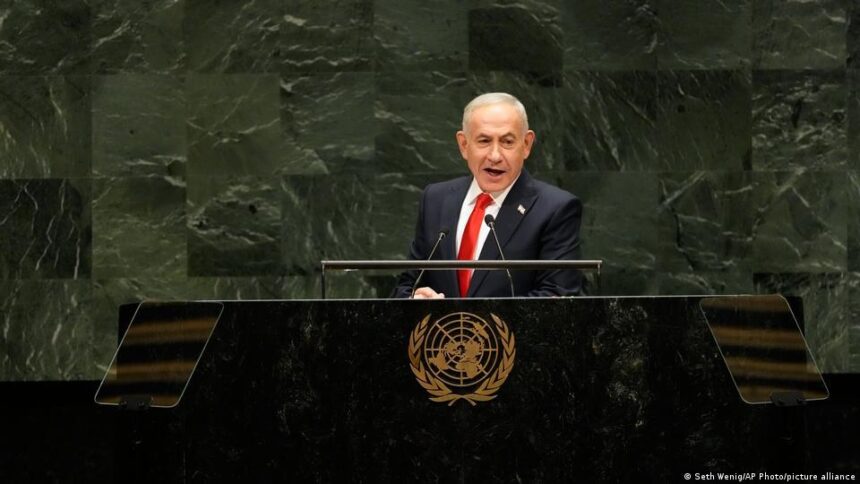
Before Israeli Prime Minister Benjamin Netanyahu’s speech at the UN General Assembly, delegations from numerous countries left the hall amid applause and jeers. Netanyahu responded to their departure with a harsh remark and called on others to leave as well if they did not want to hear his speech.
He thanked US President Donald Trump and said the two countries had worked together to “save civilization.” Netanyahu also spoke about the return of Israeli hostages from Gaza, saying that an agreement reached last year with US mediation had led to the return of the remaining hostages, both those who were alive and the bodies of those who had died.
Addressing Iran, the Israeli prime minister asked what would happen if a one-ton ballistic missile struck the UN buildings and said it would completely destroy the complex. He also criticized growing international criticism of Israel, claiming that Qatar had spent billions over the years spreading what he described as “false information” about Israel.
Turning to Turkey, Netanyahu said the country had become a state that hosts Hamas representatives and “spreads lies” against Israel. He called Turkish President Recep Tayyip Erdogan a dictator and accused him of hosting Hamas leaders.
Netanyahu also said Erdogan had killed thousands of peaceful Kurdish civilians, denied the Armenian Genocide, imprisoned thousands of journalists, illegally occupied Northern Cyprus and regularly violated Greek airspace. He made these claims during his speech.
The reactions in the hall before and during the speech showed that Netanyahu’s remarks came amid sharp political disagreements. Among the accusations directed at Turkey, the statement about denying the Armenian Genocide stood out, as Netanyahu linked it to his other accusations against Erdogan.


The accusations against Turkey and Erdogan in Netanyahu’s speech formed part of the Israeli prime minister’s broader rhetoric in response to international criticism, but the reference to denial of the Armenian Genocide stands out in this section. This is particularly notable because the same material also mentions an earlier situation surrounding the process of recognizing the Armenian Genocide in Israel.
It is important to distinguish between two things here: the political assessments voiced by Netanyahu and the factual claims underlying them. Statements made from the UN podium gain visibility on an international political stage, but assessing them requires examining the individual facts separately. In the current speech, the most direct reference related to Armenia is his statement about denial of the Armenian Genocide, while the other accusations concern Turkey’s domestic and foreign policies.