




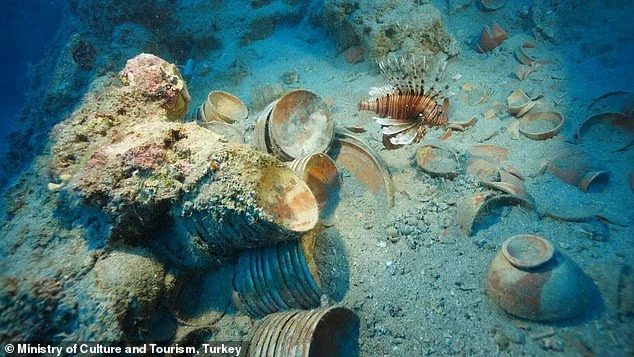
A cargo of luxury tableware has been discovered on the floor of the Mediterranean Sea, where it had remained for about 2,100 years. Archaeologists are studying a ship that sank off the coast of what is now Turkey while carrying thousands of ceramic items, many of which have been preserved in remarkably good condition.
The ship lies at a depth of about 55 meters off the coast of Adrasan in Antalya Province. It is believed to have set out from the ancient city of Rhosus, located in what is now Hatay Province, and to have been heading for Rome. Along the way, the ship encountered a storm and sank after hitting a shoal.
Underwater excavations began in 2025. During that time, archaeologists have discovered thousands of objects, including fish plates, bowls and trays. In total, researchers have identified 122 shapes and sizes of ceramic items, offering rare insight into the culture of luxury tableware in the Roman world.
The discovery is of particular interest because of the origin of the cargo. Alongside tableware from Rhosus, ceramic vessels from several Aegean islands were also found on the ship. This indicates that the vessel was simultaneously carrying goods from multiple production centers.
Rhosus tableware was in especially high demand among wealthy buyers. This is also evidenced by ancient Roman written sources. In particular, the famous Roman orator and statesman Cicero, in a letter to his friend Atticus in 50 BC, mentioned an order for ceramic items from Rhosus.
The unusually good preservation of the cargo is explained by the way it was packed. The tableware was arranged in wooden crates, and clay was placed between individual items to protect them from impacts during transport. After the ship sank, it appears that this very packaging helped save most of the cargo from destruction.



Coins found at the site date to the 1st century BC and have helped determine the time of the ship's final voyage. Now its cargo makes it possible not only to glimpse the daily life of wealthy inhabitants of the Roman world, but also to trace trade links between various centers of ceramic production in the Mediterranean.
The true value of this find lies not in individual beautiful plates, but in what the ship tells us about the organization of trade. The products of Rhosus and the Aegean islands are combined on the same ship, which means that in the 1st century BC there was a multi-source supply network operating in the Mediterranean, in which intermediaries gathered goods from different centers into a single cargo destined for a wealthy Roman buyer.
The role of packaging is especially noteworthy. What we would today call logistics saved most of the cargo 2,100 years ago: the wooden crates and clay interlayers acted as modern shock absorbers. Without that, we would now have a pile of ceramics rather than a collection of 122 shapes and sizes.
The correspondence with Cicero's letter is also interesting. He ordered tableware from Rhosus in 50 BC, almost the same period to which the ship's coins are dated. This is a rare case in which a written source and an archaeological find mutually confirm each other, making the picture far more reliable than in the case of an ordinary underwater discovery.