



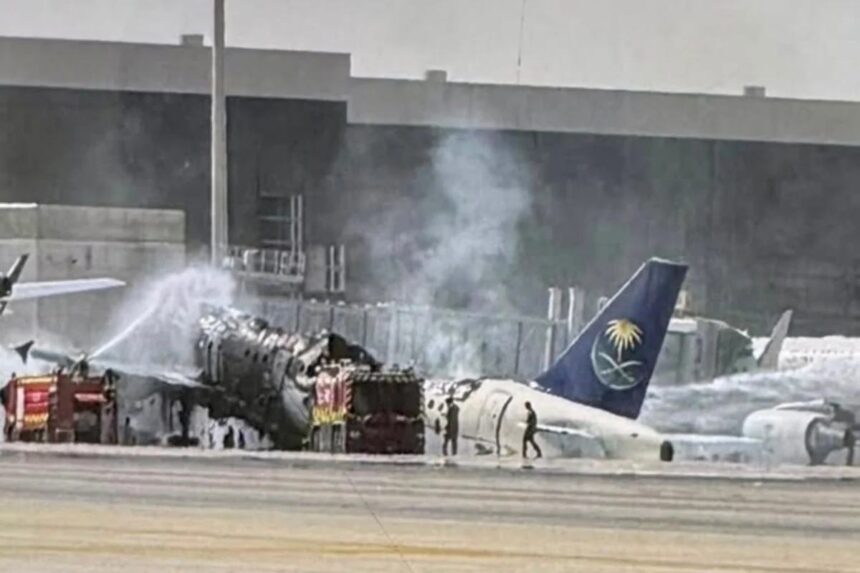
At least 12 people were killed and another 309 injured in an attack on King Khalid International Airport in Riyadh, the capital of Saudi Arabia. The figures were released on October 11 by Saudi Arabia's General Authority of Civil Aviation.
A diplomatic source attributed responsibility for the attack to Yemen's Houthis, who launched a missile toward the airport.
Among the dead are four Saudi citizens, two Bangladeshi nationals, and one citizen each from the United States, Egypt, Jordan, Syria, Palestine, and Sudan. Several of the injured are in serious condition.
This is the third attack on the airport in a single week. The previous two attacks killed four people, and a Saudi commercial aircraft sustained serious damage.


Hospitals were overwhelmed, and the injured were transported by ambulances and helicopters. There was no warning of the attack, and Saudi Arabia's danger notification system did not function. After Saturday's attack, all flights were redirected from Riyadh to other airports. Operations at the airport, which serves a city of about 8 million people, were temporarily suspended.
The Houthis declared on the social network X that aircraft should avoid Saudi Arabian airspace, declaring it a "zone of military operations."


The fact that three attacks on the airport occur within a single week, and that there was no warning about any of them, is telling in itself. Saudi Arabia's danger notification system, which should have functioned in such cases, remained silent this time as well. This raises questions not only about the frequency of the attacks, but also about the effectiveness of defenses against them.
The temporary suspension of the only major airport serving a city of about 8 million people has serious consequences not only for Saudi Arabia, but for aviation connectivity across the entire region. The redirection of flights to other airports shows how fragile this infrastructure can be even under short-term crises.
The Houthi statement declaring Saudi Arabian airspace a "zone of military operations" means that tensions may only escalate in the near future. It remains unclear how Saudi Arabia will respond, and whether international airlines will continue flights to Riyadh. The answers to these questions will shape the region's security picture in the coming days.