



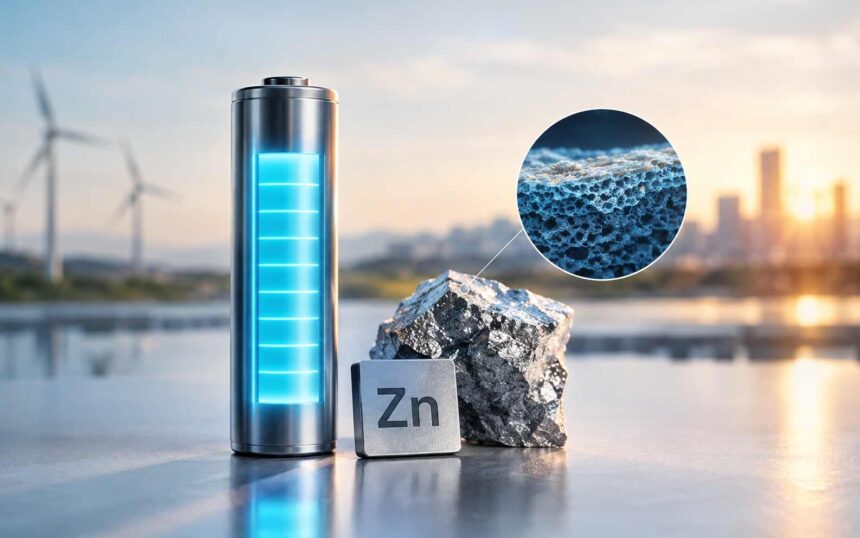
Scientists have created a new catalyst based on iron, nickel and carbon. During laboratory tests, it enabled a zinc-air battery to be charged and discharged up to 500 times. This is a major breakthrough, as recharging these batteries had remained an unsolved technical problem for many years.
Zinc-air batteries can theoretically store more energy than lithium-ion ones, which are the most widely used today. It is precisely this potential that has attracted researchers for years, but the biggest obstacle on the path to practical application was the recharging problem itself. The new material could contribute to the creation of more efficient energy storage devices, which is important from the perspective of both energy and technological development.
Research on zinc-air batteries has been ongoing for decades, but reaching practical production has been slow. This new result shows that the problem may be more solvable than it seemed, though there is still a long way from laboratory experiments to the real market.
Importantly, the catalyst is based on iron, nickel and carbon — relatively affordable materials. If this approach is confirmed at industrial scale as well, the production of energy storage devices could become cheaper and less dependent on expensive and scarce raw materials.
At the same time, 500 cycles is a laboratory indicator, and it is not yet known how the material will retain its properties under conditions of temperature, humidity or long-term use. It is precisely the answers to these questions that will determine whether this discovery remains a scientific curiosity or becomes a real technology.