



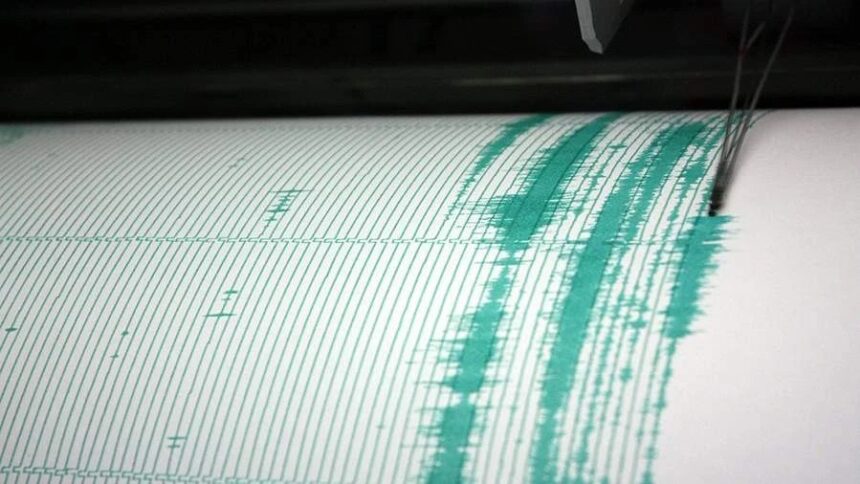
A powerful underground tremor was recorded in eastern Japan early Sunday at around 02:00 local time. Preliminary data put the earthquake's magnitude at 5.9, with the epicenter located in the southern part of Ibaraki Prefecture at a depth of approximately 68 kilometers. The tremors were felt in the capital and a number of surrounding areas, but no tsunami warning was issued.
In parts of Ibaraki, Saitama, and Chiba prefectures, as well as Tokyo's Adachi Ward, the quake registered up to 5 on Japan's seven-point seismic intensity scale. Such tremors typically cause most people to feel fear and try to hold onto something, while objects may fall from shelves.
Several people sustained injuries as a result of the earthquake. Among the injured are a young man and a woman around 70 years old in Saitama, as well as three other individuals in the city of Kawasaki, south of Tokyo.
The tremors also caused disruptions to train services, with speeds reduced on some routes and delays reported on others. Operations on the Keisei Line, which connects central Tokyo with Narita Airport, were later restored, while some express trains on the Tobu Railway line remain suspended.


A water pipe was damaged in Tokyo's Koto Ward, and authorities are investigating whether this incident is linked to the earthquake. Meanwhile, no abnormalities were detected at the Tokai No. 2 plant in Ibaraki, nor at the Fukushima Daiichi and Daini nuclear plants.
Prime Minister Sanae Takaichi has already instructed relevant agencies to assess the extent of the damage and keep the public promptly informed about the situation. The Meteorological Agency, which issued an emergency warning, has called on residents to remain cautious over the coming week, especially over the next two to three days, as the likelihood of new tremors of up to magnitude 5 remains high.



This earthquake serves as yet another reminder of how unpredictable nature can be, particularly for a country like Japan located in a seismically active zone. Fortunately, the number of casualties is not large, but the damage to infrastructure and disruptions to transport highlight the importance of a rapid response system.
It is noteworthy that no anomalies were detected at the nuclear plants, which provides some reassurance, especially after the Fukushima tragedy. At the same time, the Meteorological Agency's warning about the possibility of strong aftershocks in the coming days is concerning. The coming week will likely be crucial for understanding further developments.