




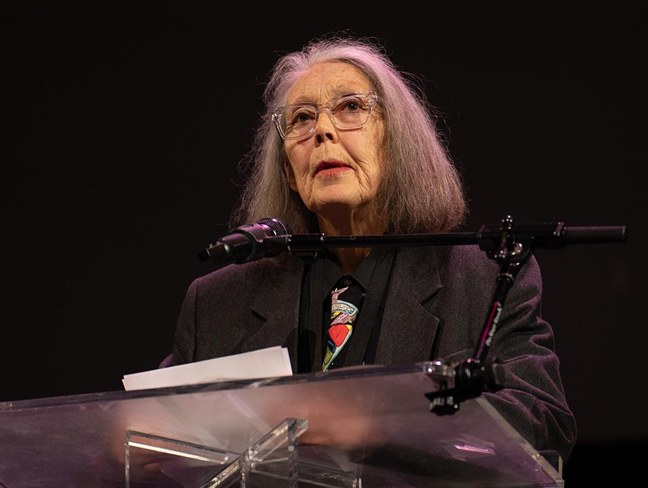
The 2026 Nobel Prize in Literature has been awarded to Canadian poet, essayist and translator Anne Carson. The Swedish Academy praised her innovative literary body of work, particularly her unique dialogue with classical literary traditions.
Carson was born in Toronto in 1950. She became interested in Ancient Greek while still at school and later studied classics at the University of Toronto, where she received her doctorate in 1981. She has taught at various universities in Canada and the United States, including Princeton University and the University of Michigan.
Carson’s work is characterized by the blending of different genres. She has combined ancient Greek mythology, contemporary poetry, philosophical essays and visual art, and has also translated works by Sappho, Euripides and Sophocles.
She gained international recognition with her 1998 verse novel “Autobiography of Red,” a modern reimagining of the ancient Greek myth of Geryon. In the book, Geryon is portrayed as a sensitive teenager who is interested in photography and falls in love with a young man named Herakles. The work explores coming of age, first love, loneliness and the search for identity.
Another of Carson’s best-known works is the poetry book “The Beauty of the Husband,” which won the T. S. Eliot Prize in 2001. Carson became the first woman to receive the award. In 2010, she also published “Nox,” an experimental book dedicated to her late brother that combines memories, photographs, letters, collages and ancient Roman poetry.
The 2026 Nobel laureate will receive 12 million Swedish kronor, approximately €1.1 million. This year, the monetary component was increased by one million kronor.



The Nobel Prize in Literature has been awarded since 1901, with the laureate selected by the Swedish Academy. In 2025, the prize was awarded to Hungarian writer László Krasznahorkai.
In Carson’s case, the Nobel Prize stands out not only for her literary achievements but also for the way she has connected different eras and forms. In her books, ancient Greek myths do not remain simply stories from the past; they become a means of speaking about the love, loneliness, loss and search for identity of modern people. This approach is particularly evident in “Autobiography of Red,” where the myth of Geryon takes on a completely different human focus.
The same logic continues in “The Beauty of the Husband” and “Nox,” but through different themes. In one, marriage and infidelity are at the center; in the other, memory and grief. The diversity of Carson’s work shows that her literature is difficult to fit into a single genre, and it is precisely this crossing of boundaries that forms a central part of her creative identity.