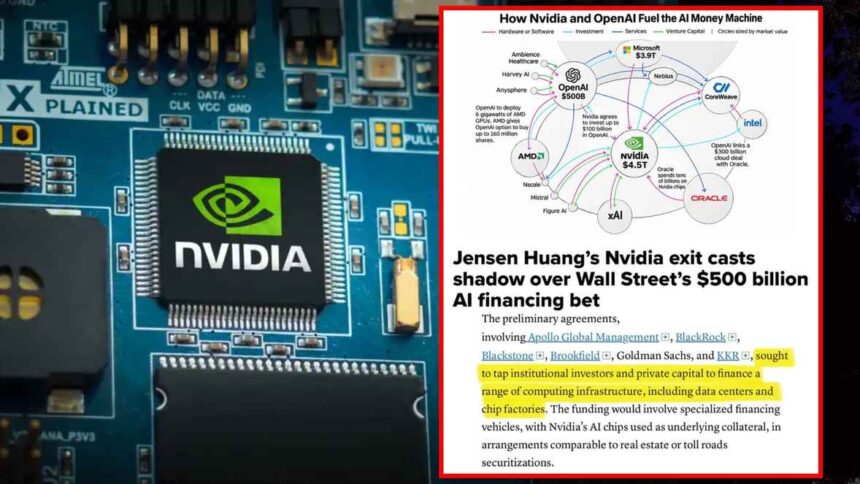
US technology giant Nvidia has found itself at the center of serious financial problems that could threaten the financial bubble surrounding artificial intelligence in the United States. The company’s financial reports show that under CEO Jensen Huang, Nvidia has entered a difficult situation from which it may struggle to emerge, potentially even putting the company’s survival at risk.
At the heart of the problem are deals with artificial intelligence startups. Nvidia provided them with billions of dollars in credit guarantees, allowing the startups to build data centers and purchase the company’s chips. If they were unable to use or sell their computing capacity, Nvidia promised to buy it back so that the startups could continue purchasing its chips.
Under this arrangement, Nvidia was simultaneously an investor, lender, supplier and buyer of last resort. This helped artificially inflate the company’s market value. However, the situation changed when major artificial intelligence companies did not switch to using their own in-house chips, while Nvidia had already signed stringent contracts with suppliers, committing to purchase $279 billion worth of components.
The company’s total liabilities have already exceeded $530 billion. That figure is several times greater than its annual net profit.

These contractual commitments could turn into a heavy financial burden at any time. If this business model collapses, startups and companies dependent on Nvidia could go bankrupt. At the same time, shares in Nvidia and major US technology companies would also be at risk.
What makes Nvidia’s situation particularly noteworthy is that the company’s financial risks are tied not only to sales of its own products but also to the financial stability of its customers. When the same company finances a startup, sells it chips and simultaneously guarantees to buy back its computing capacity, the success of these transactions depends heavily on the continued growth of a single market.



This is the fundamental vulnerability of the entire arrangement. If demand for artificial intelligence services fails to meet investors’ expectations, problems could emerge on several fronts simultaneously: startups could lose revenue, Nvidia could face its contractual obligations, and technology stocks could come under pressure. It remains unclear how much of these commitments will translate into actual payments, but the $530 billion figure shows that the growth of the artificial intelligence market is not just a technological race; it also rests on substantial financial risks.