




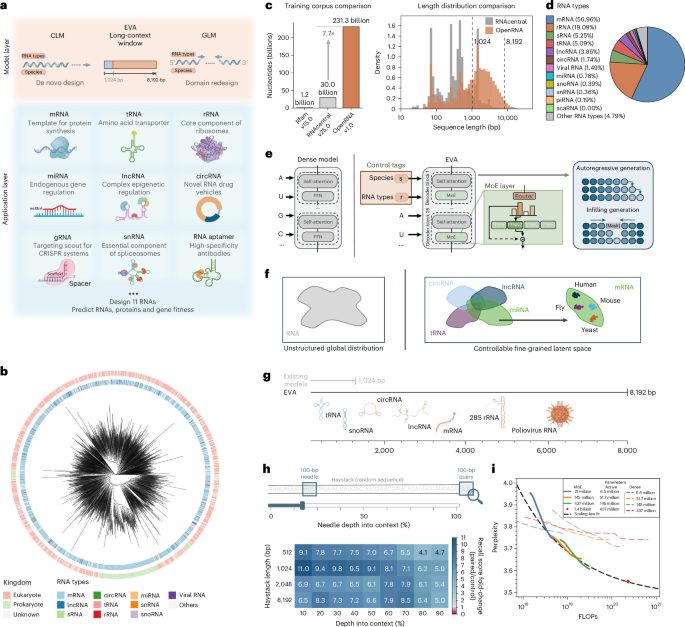
Scientists have developed an artificial intelligence system called EVA that can design RNA molecules with different functions. The system was trained on more than 114 million complete RNA sequences representing the evolutionary diversity of living organisms. The study was published in the scientific journal Nature Machine Intelligence on November 27, 2026.
EVA uses a combined architecture of specialized components and can process sequences containing up to 8,192 tokens at a time. This allows the system to account for both the overall structure of RNA and the functions of individual regions. It can predict the effects of genetic changes and design new sequences for various biological tasks.
Researchers tested the system on several types of RNA, including transfer RNA, aptamers, guide RNA used in CRISPR systems, as well as messenger RNA and circular RNA being studied for therapeutic applications. In laboratory experiments, EVA's best-designed aptamers performed approximately twice as well as a positive control sample in both fluorescence intensity and their ability to bind to the target molecule.
The system also outperformed previously recorded best results in seven out of nine established benchmarks. The statistical features of the secondary structures of the generated RNA sequences were more than ten times closer to those of natural RNA than the results produced by the previous open-source generator. EVA's source code, model data and experimental results have been made publicly available.

The development of EVA opens up new possibilities for applying artificial intelligence to RNA research. Until now, one of the main limitations of such systems has been the difficulty of working with long sequences and their complex structures. The new model seeks to address precisely this challenge by drawing on a large evolutionary database.
The findings are particularly interesting for drug development and genetic technologies, as accurate RNA design can affect a molecule's stability and function. However, success in computer modeling must be distinguished from laboratory validation. In this study, the performance of the designed aptamers was tested through actual experiments, but this does not mean that all RNA molecules designed by the system are ready for medical use. An important task for future research will be to determine how well these results hold up under different biological conditions.