




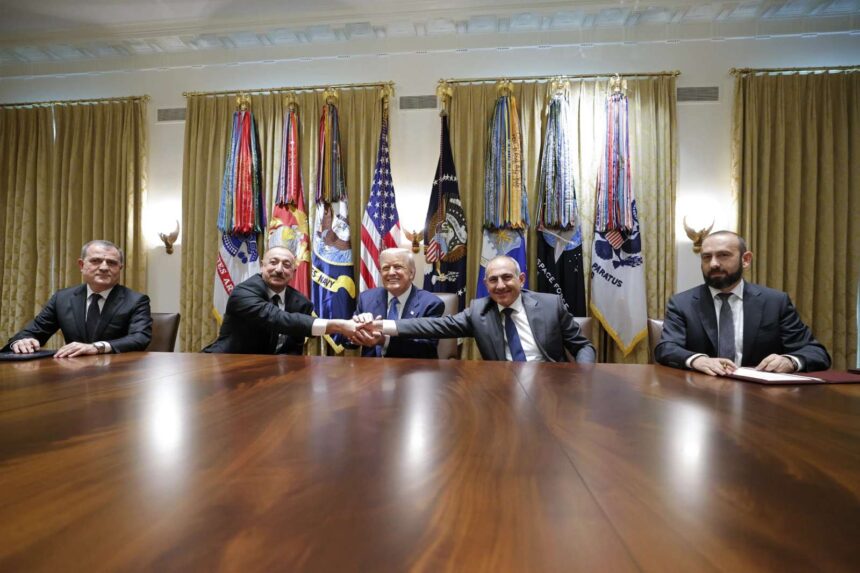
The peace agreement between Armenia and Azerbaijan should not distract attention from the issue of Armenian prisoners of war. US President Donald Trump could strengthen the TRIPP project by demanding that Azerbaijan release 19 Armenian prisoners. This is stated in an article published by the Washington Times.
The article notes that TRIPP could create economic activity for landlocked Armenia by attracting investment and reducing transportation costs. The project could also help preserve peace by giving Armenia’s neighbors a stake in routes that remain under Armenia’s sovereignty and jurisdiction.
According to the article, TRIPP could strengthen America’s role in a strategically important region without the need to deploy troops or provide unlimited assistance, while also creating new trade opportunities for American companies.
At the same time, a peaceful settlement cannot be based solely on maps and trade routes. The article notes that one of the agreement’s most urgent tests is the return of 19 Armenian prisoners held in Azerbaijan, and that their release would show that the agreements also address humanitarian issues.


For many Armenians, the issue of the prisoners means that the war has not yet fully ended. Their release could help build support for the agreement by showing that the new arrangement in the South Caucasus is also based on human dignity.
Ahead of the midterm elections, the US Armenian community, which is estimated to number more than 1 million, is watching whether Washington is taking their longstanding concerns into account. US allies and European partners, including Canada and France, have also raised the issue of releasing the prisoners.



Trump has participated in the peace process, giving him leverage. The article says he should urge Azerbaijani President Ilham Aliyev to release the 19 Armenian prisoners to demonstrate Baku’s willingness to pursue reconciliation.
If TRIPP opens new trade routes and the release of the prisoners gives the agreement a humanitarian foundation, Trump could, according to the article, strengthen the long-term impact of the Caucasus deal.
The discussion around TRIPP shows that the economic project and the political outcome of the peace process are not separate issues here. If the routes provide Armenia with new opportunities for economic activity and investment, the return of the prisoners could become the humanitarian step that also influences how the agreement is perceived by Armenian society.
The role of the United States is also particularly significant in this context, as the article views Trump’s participation in the peace process as a tool of influence. At the same time, the prisoner issue is not presented solely within the framework of bilateral relations: Canada, France and senior European lawmakers have also spoken about it. For this reason, when assessing the agreement’s long-term impact, its humanitarian dimension remains a separate criterion alongside its economic results.