
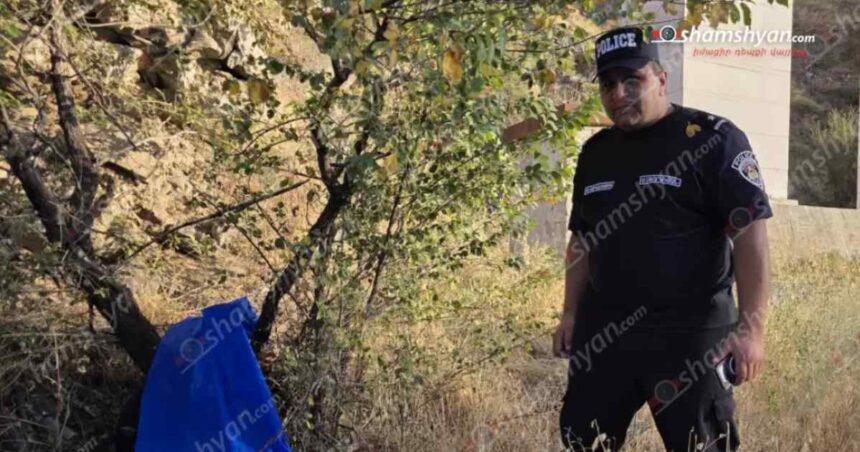
A death was recorded in Yerevan on September 17. At around 16:50, the Davtashen division of the Main Directorate of Community Police of the Ministry of Internal Affairs of Armenia received operational information that there was a body under the Davtashen bridge.
The operational group of the Davtashen police division arrived at the scene, led by division head Zorik Avdishoev and deputy division head Zhirayr Sedrakyan. At the scene, it was established that the received information was accurate.
Patrol officers of the 3rd battalion of the Yerevan city regiment of the Patrol Service of the Ministry of Internal Affairs of Armenia also arrived at the scene, led by deputy battalion commander Karen Avetisyan. At the location, community police officers found the body of a man in a semi-decomposed state.
At this point, it appears to have been established that the area where the body was found falls under the jurisdiction of the Arabkir administrative district, and Davtashen community police officers are waiting for the arrival of officers from the Arabkir police division. On the instruction of Davtashen police division head Z. Avdishoev, community police officers are working to establish the identity of the deceased, who, however, is unrecognizable and cannot be identified.



In the very first hours of the incident, what is noteworthy is not the fact of the body's discovery, but how territorial jurisdiction changes the course of the police response. Davtashen community police officers arrived, recorded the scene, and are waiting for their Arabkir colleagues, since the section under the bridge turns out to fall under the jurisdiction of another administrative district. This is an ordinary situation, but it is precisely in cases like this that it becomes evident how much time is lost before the responsible unit arrives. And time here is of direct importance: the body is semi-decomposed, the identity cannot be established, and the later the actual investigation and identification work begins, the less chance there is of reconstructing the true picture of the incident.
The most important questions remain open for now: who the deceased is, how long he remained under the bridge, and whether the death was the result of foul play or not. Police have not yet reported either the cause or the estimated time of death, and it would lack seriousness to put forward any hypothesis before the forensic examination conclusion. What remains is to follow whether identification succeeds, and what that will change in the course of the investigation.