


Kyrgyzstan’s Foreign Ministry has sent a diplomatic note to Russia’s Foreign Ministry, demanding the swift return of a Kyrgyz citizen who is being held at one of Russia’s military units.
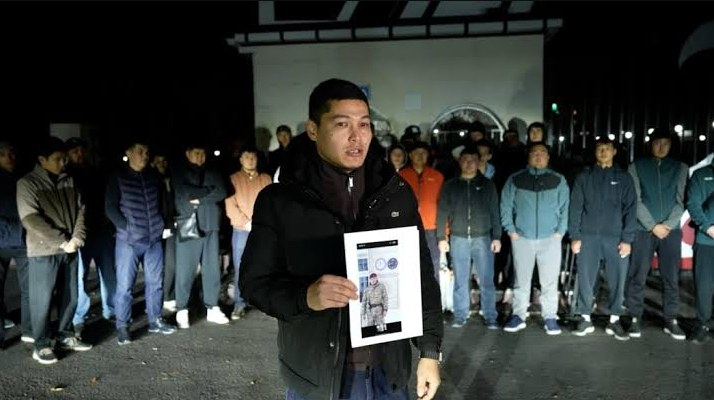
The man is 21-year-old Elistan Toktogulov. His relatives and friends published a video in Manas on November 3, saying that the young man had been forced to sign a military contract and sent to Voronezh for military training, after which he was expected to be deployed to fight in the war against Ukraine.
According to his older brother, Elistan was looking for a job on Instagram when he got in touch with a Kyrgyz man living in Russia, who offered him a position with a monthly salary of 105,000–110,000 rubles. A ticket was purchased for him, and on October 28, he traveled to Moscow, where he checked into a hotel.
His brother said that another Russian citizen met him at the hotel, took his passport and told him to get some rest. At around 3 a.m. that night, he was taken in an unidentified vehicle to another location and beaten. Since Elistan does not speak Russian, he was forced to sign documents without understanding them, after which he was transferred to a training center in Voronezh.

Kyrgyzstan’s Foreign Ministry said that the country’s embassy in Moscow had contacted the relevant Russian authorities, demanding an investigation into the incident, the identification of those responsible and that they be held accountable. The embassy remains in constant contact with Toktogulov’s relatives.
It is not known how many Kyrgyz citizens are participating in Russia’s war against Ukraine overall. No official figures are available. According to data from Ukraine’s state-run “I Want to Live” project, 2,219 Kyrgyz citizens have taken part in the war since 2022.



The same project claims that since the beginning of Russia’s full-scale invasion, Moscow has recruited 20,437 citizens from five Central Asian countries—Kazakhstan, Uzbekistan, Kyrgyzstan, Turkmenistan and Tajikistan—to serve in its armed forces. They account for 44 percent of all foreign nationals identified in the Russian military.
Kazakhstan had previously also begun bringing home its citizens who had been recruited to serve in the Russian military and take part in the war against Ukraine. As a result, several Kazakh citizens have returned home.
Toktogulov’s case illustrates how a job offer can turn into a dangerous situation when someone travels to another country and falls under the control of people whose intentions are not known in advance. The language barrier is another particular concern in this case, as, according to his brother, it left the young man unable to understand the contents of the documents he was forced to sign.
The appeal by Kyrgyzstan’s authorities to Russia is currently the main diplomatic step in the case, but it remains unclear what the investigation will establish and when the young man might be able to return home. The figures released by the Ukrainian project also indicate that the problem extends beyond the concerns of a single family. At the same time, these figures are not official statistics and should be treated as estimates published by the project. Kazakhstan’s experience shows that the return of citizens can also become a subject of negotiations between states.