



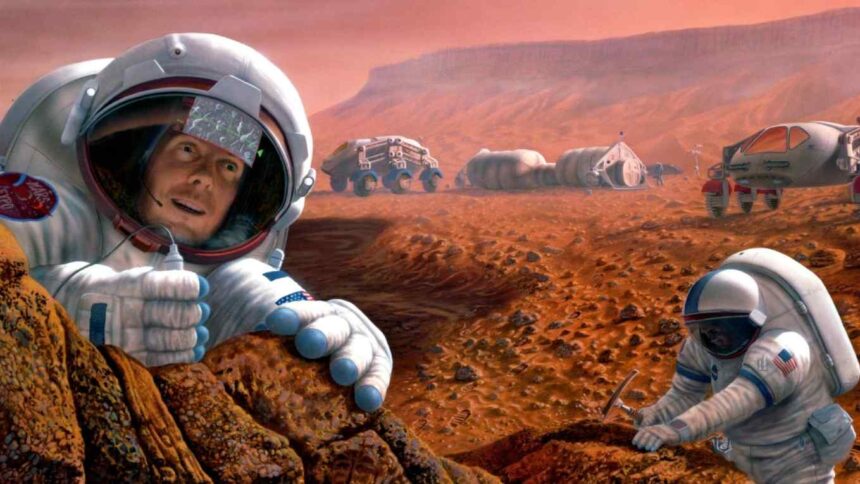
“I think humans will still go to space, explore Mars and beyond, but we will be in interesting company.” These words belong to Pascal Lee, a planetary scientist at the SETI Institute, president of the Mars Institute and director of NASA’s Haughton-Mars Project, who recently addressed the impact of artificial intelligence and robotics on Mars colonization plans.
“Artificial astronauts” could fly as members of a real crew to Mars and other parts of space. These durable, space-adapted artificial humans, as supporters note, have major advantages: they will not require the large amounts of consumables needed to keep humans alive and will be able to perform spacewalks without a life-support system.
Although not everyone would agree with the projected pace of development in robotics and artificial intelligence, the idea is that progress will be rapid — in line with the timelines on which Mars missions are planned and carried out, unlike in the past. As Pascal Lee explains, this forces serious strategic thinking about what capabilities and systems should be developed and included in missions, and which will nevertheless mature thanks to broader societal developments in robotics and AI.
Lee notes that we are entering an “AI era,” and robotics and artificial intelligence are taking steps toward creating the first artificial humans — androids endowed with the same physical characteristics and mobility as humans and equipped with artificial general intelligence (AGI). He raised this topic at the Space Robotics Workshop held in late July, titling his talk “Humans to Mars in the AI Era.”

This discussion goes beyond a purely technological question. If artificial astronauts do indeed become the main force of Mars missions, then first of all the answer changes to the question of why we are sending humans there at all. The logic of risk, cost and life support that determined space programs for decades works completely differently here.
On the other hand, Lee’s remarks about considering androids “our generation” will still sound strange to many, and that is normal; drones were perceived the same way decades ago. The question is how much these predictions align with real timelines, in which, as in Musk’s case, everything depends on whether the landings succeed.



In the coming years, it is worth following not the statements but the result of the first uncrewed flight: that is where it will be decided whether the artificial astronaut remains a beautiful idea or becomes the first active participant in the colonization of Mars.