

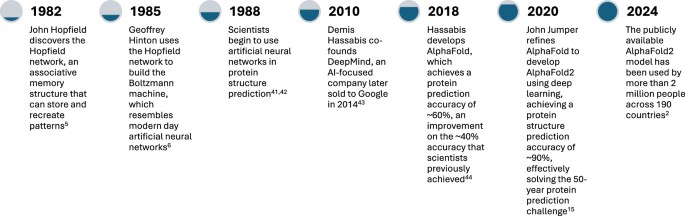
In October 2024, the Nobel Committee in Stockholm announced that the prizes in physics and chemistry are being awarded for work related to artificial intelligence (AI). The physics prize went to John J. Hopfield and Geoffrey Hinton (formerly of Google) for fundamental discoveries and inventions that made machine learning possible through artificial neural networks. Half of the chemistry prize was awarded to David Baker for "computational protein design," and the other half to DeepMind's Demis Hassabis and John M. Jumper for "protein structure prediction."
Hopfield created the Hopfield network, an associative memory structure that can store and retrieve information. Building on that network, Hinton developed the Boltzmann machine, a method that can independently discover properties in data. These discoveries form the foundation for artificial neural networks, allowing them to classify and analyze enormous volumes of data, process information quickly, learn effectively, and form memory. Today, neural networks enable computers to make predictions, interpret images, and hold human-like conversations. For example, the well-known ChatGPT tool developed by OpenAI became possible thanks to the discoveries of Hopfield and Hinton.
This decision directly affects science funding and research priorities. When the Nobel Committee awards the physics and chemistry prizes to computer algorithms, it signals that interdisciplinary boundaries are becoming increasingly conditional. Universities and laboratories will be forced to reconsider how they train future scientists: a pure physicist or chemist can no longer ignore machine learning tools.
At the same time, Hinton's departure from Google and his explicit warnings point to a more troubling trend. The same person whose work laid the foundation for today's most powerful technologies speaks about its dangers without softening his words. That is not rare in the history of science: Joliot-Curie's warning about the atomic bomb became painfully relevant years later. Here the question arises: are we learning from history, or repeating the same mistake, this time faster?
In healthcare, tools like AlphaFold2 are undoubtedly changing the rules of the game, but their use in clinical practice still requires careful verification. Algorithmic bias, data privacy, and the impact on doctor-patient trust are serious challenges that will not be solved by a single Nobel Prize.