



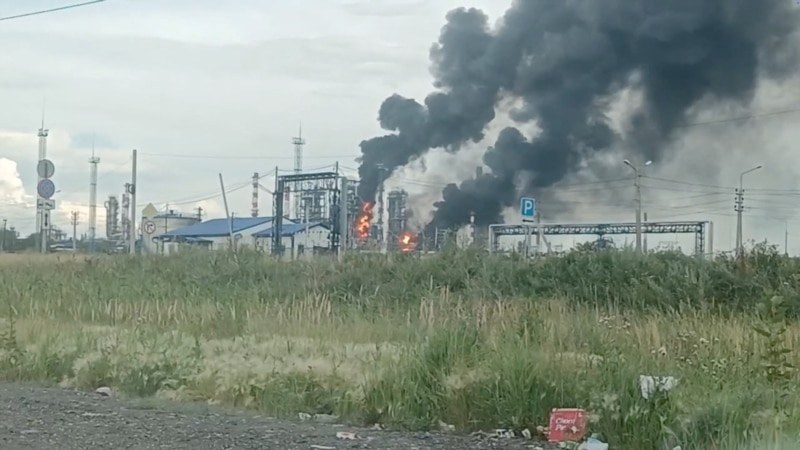
Ukraine has again struck Russia's largest oil refinery in Omsk with drones. The information was circulated by Telegram monitoring channels, cited by Radio Liberty's Russian service.
Omsk Governor Vitaly Khotsenko wrote that air defense forces are "repelling the enemy attack," but he did not provide other details. Local residents report on social media that explosions are heard and smoke is visible near the oil refinery, and a drone alert has been declared in Omsk. Explosions and alarm signals are also heard in other parts of the city.
The Telegram channel "Omsk Civil Resistance" reports protests by university and college students that they are being refused evacuation despite air raid signals. "The lecturer continues giving lectures while the signals sound, and students are asked to sit and take notes," the channel writes. Students claim this is not the first time this has happened in at least dozens of educational institutions.
The Omsk oil refinery was first subjected to a mass attack by Ukrainian drones on July 6 of this year, after which the refinery stopped operations. The distance from Omsk to the Ukrainian border is more than 2,500 kilometers.
The Omsk refinery is Russia's largest oil refinery, with a capacity of about 21 million tons per year. In the spring and summer of 2026, Ukrainian forces struck, sometimes repeatedly, all major oil refineries in the European part of Russia. Fuel shortages arose in many regions of Russia, partly due to the shutdown of refineries after those strikes.
This strike shows that Ukrainian drones can also reach deep into Russia, more than 2,500 kilometers from the border. The problem is that the Omsk refinery has the country's largest refining capacity—about 21 million tons per year—and its repeated shutdown could have a serious impact on the fuel market. After July 6, the refinery had already stopped, and now the question arises of how quickly operations can be restored.



Also noteworthy is that local students are protesting the refusal of evacuation despite air raid signals. This is no longer only a military but also a civil defense issue, which could affect public sentiment. Fuel shortages in many regions of Russia have already been felt this year, and such strikes could exacerbate the situation.
It is still unknown what specific damage was caused to the refinery this time, and whether it will lead to a new production shutdown. It is also unclear how the Russian side will react, given that air defense, according to the governor, is still "repelling" the attack.