



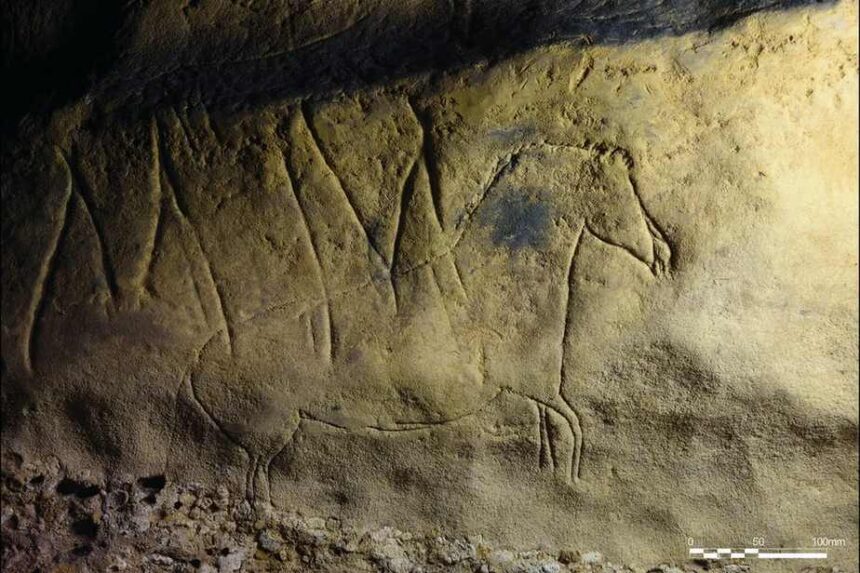
Archaeologists have discovered 280 Paleolithic engravings in the Cova de la Font Major cave in Catalonia, northeastern Spain. Among them are 55 depictions of animals, as well as numerous abstract symbols and geometric patterns. People visited this cave for centuries, but the ancient images went unnoticed until 2019. The findings were published in the journal Antiquity.
The cave had drawn the attention of tourists, researchers and treasure hunters since the mid-20th century, and in 1993 it became an official tourist attraction. Josep Maria Vergès, a co-author of the study and a researcher at the Catalan Institute of Human Paleoecology and Social Evolution, noted that over several decades thousands of visitors walked past the engravings, and some even left their own inscriptions on top of the ancient images.
Scientists long believed that the cave's wall surface was unsuitable for creating Ice Age engravings, which partly explains why the discovery was made so late.
The collection found is of particular importance for the study of prehistoric art on the Iberian Peninsula. Although more than half of Europe's known Upper Paleolithic cave art is located here, most of it is concentrated in the Franco-Cantabrian region spanning Spain and France. Before the new discovery, only two Ice Age animal depictions were known in Catalonia.
At about 75% of the known sites on the Mediterranean coast of the Iberian Peninsula, the number of animal depictions does not exceed five, and at more than 90% it does not exceed 20. In this context, the 55 depictions at Cova de la Font Major make the cave one of the region's most significant sites.
The most interesting detail of this discovery is not what was found, but how long it sat in plain sight. For decades, thousands of people passed through the cave, and some even left inscriptions on the very walls where the Ice Age engravings were later found. This is a good illustration of how much archaeological discoveries depend not only on technology, but also on what questions we ask and how we look.



For years, scientists were confident that the surface of this cave's walls was unsuitable for creating such images, and it was precisely this assumption that delayed the discovery. When you are convinced in advance that something does not exist, it is hard to notice it.
For Catalonia, this is a major shift: until now only two Ice Age animal depictions were known here, and now there are 55 — in a single cave. The researchers' call for systematic study is entirely logical: if something like this could remain hidden in such a heavily visited place, it is hard to imagine what might remain unstudied in quieter regions.