



Light can transmit vast amounts of information, yet building faster and more efficient optical communication systems requires precisely controlling its movement. Scientists have made notable progress studying barium titanate (BTO), a promising material that could improve the performance of future devices that transmit data using light.
A research team led by KAIST has obtained detailed data on how light passes through BTO and how much light the material absorbs. These properties had been difficult to measure accurately for decades due to the crystal's complex internal structure, and the new findings give engineers a more reliable foundation for designing optical devices that reduce signal loss and enable faster data transmission.
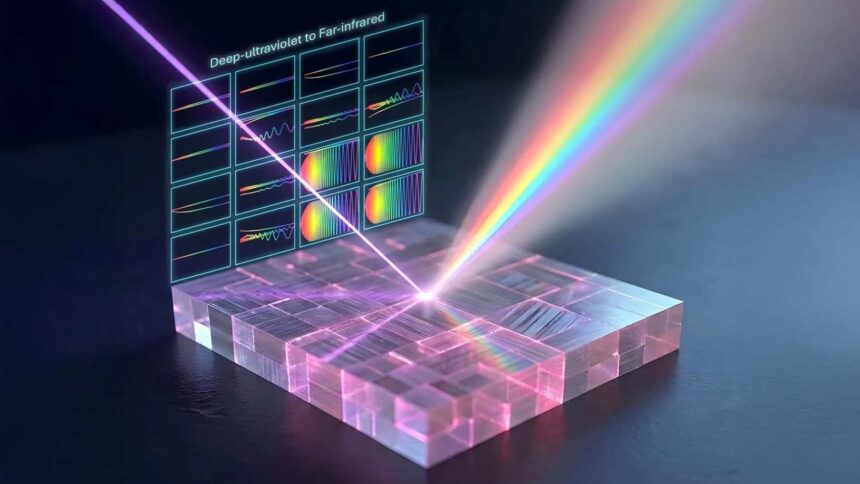
KAIST, led by President Chung-Sik Bae, announced the results on November 8. The study was led by Professor Min Seok Jang of KAIST's School of Electrical Engineering, in collaboration with the group of California Institute of Technology (Caltech) Professor Harry A. Atwater, the Korea Research Institute of Standards and Science (KRISS), and the U.S. company J.A. Woollam Co. Together, the researchers examined BTO's interaction with light across wavelengths ranging from ultraviolet to far-infrared.
One of BTO's most valuable characteristics is that it alters its effect on light under the influence of electricity. Known as the Pockels effect, this phenomenon gives the material a strong electro-optic response and makes it particularly attractive for optical modulators, which convert electrical information into signals transmitted via light.


These results show that one of the main obstacles in developing optical devices has not been a shortage of material, but inconsistent measurements stemming from its complex structure. When different regions respond differently to light, bulk measurements often produce contradictory results.
In the next phase, the focus will be on how these precise measurements will be applied in real-world manufacturing solutions and quantum photonics. According to Professor Min Seok Jang, this provides a reliable basis for evaluating how the material interacts with light, while practical outcomes will depend on further engineering development.