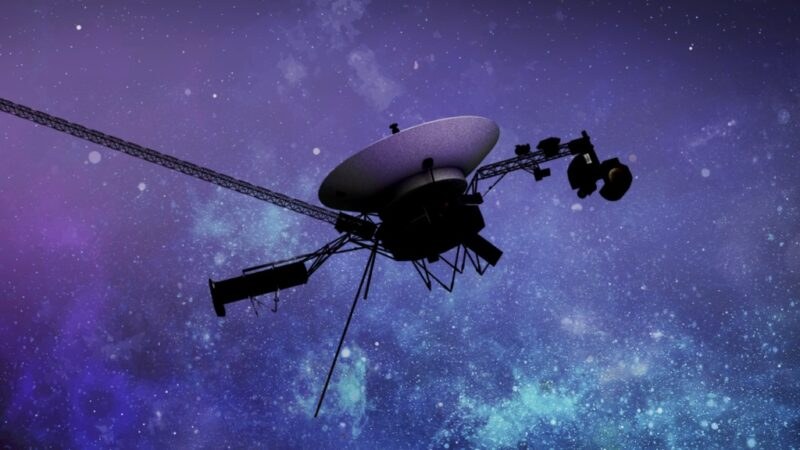
On November 18, 2026, humanity marked an important milestone in the history of space exploration: the Voyager 1 spacecraft reached a distance of one light-day from Earth. This means that light now takes 24 hours to travel from the spacecraft to Earth.
Voyager 1 is the most distant human-made object in existence. It was launched into space on September 5, 1977, explored Jupiter and Saturn, and then continued its journey toward the outer boundaries of the Solar System. In 2012, it crossed the heliopause, the boundary of the Sun's sphere of influence, and entered interstellar space.
On November 18, at 14:16 Yerevan time, the spacecraft reached a distance of one light-day from Earth. That is approximately 25.9 billion kilometers, or 173.14 astronomical units. Voyager 1 took 49 years, 2 months and 11 days to cover this distance. If we could see it through a telescope from Earth, we would be seeing the light it emitted 24 hours earlier.
To mark the occasion, NASA organized a worldwide initiative called "Shine Bright." After sunset on November 17, people used flashlights, mobile phones and glow sticks to transmit the letters V-G-R, spelling out the name Voyager, toward the sky using Morse code.


On November 18, The Planetary Society also hosted a free livestream during which space artist Don Davis presented an image of Voyager 1 from a distance of one light-day. Participants also included Suzanne Dodd, mission manager at NASA's Jet Propulsion Laboratory, program manager Karim Badaruddin, and project scientist Linda Spilker.
Bill Nye, The Planetary Society's chief ambassador, also took part and recalled that these missions have given people on Earth a new understanding of the universe and our planet over the past 49 years.



Voyager 1's journey shows how long the impact of a scientific mission can last. The spacecraft was launched when most people alive today had not yet been born, yet the data and images it has collected continue to reshape our understanding of the universe. Another remarkable aspect is that the spacecraft is still maintaining contact with Earth, despite its capabilities becoming increasingly limited with each passing year.
The next phase of the mission is focused on using the remaining power as efficiently as possible. Switching off instruments means fewer opportunities for scientific measurements, but maintaining communication is valuable in itself. The prediction that Voyager 2 will reach the same distance in 2035 also shows that the two missions have different timelines ahead of them. Their golden records, regardless of whether they are ever discovered, have already become one of humanity's symbolic messages to the cosmos.