


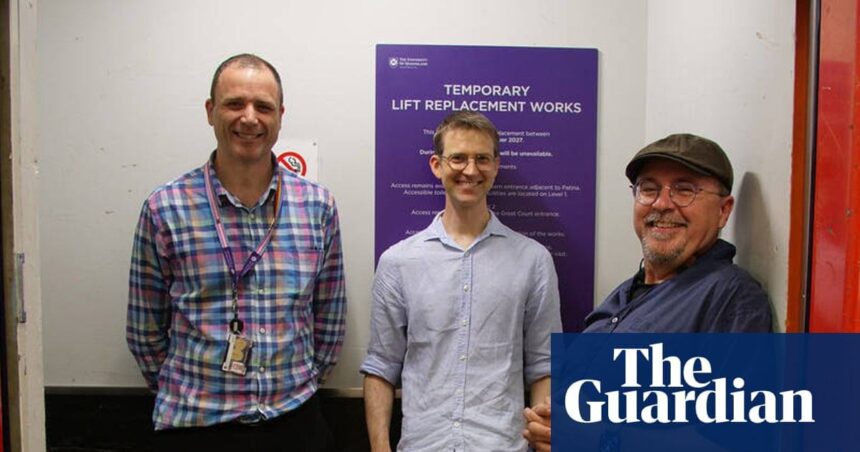
Australian physicists have demonstrated experimentally that gravity can be used to transmit messages without radio waves or other electromagnetic signals. They transmitted the word "gravity" through a brick wall over a distance of about 70 centimeters by moving an elevator between two floors and measuring the resulting changes in the gravitational field.
Scientists at the University of Queensland used an elevator built in the 1950s and installed a sensitive device called a gravimeter in a men's restroom next to it to measure the gravitational field. The device recorded changes in the position of the elevator's 1.8-ton counterweight. The scientists encoded these movements using a binary system of zeros and ones.
During the experiment, they transmitted the word "gravity." Sending a single bit took one minute, while transmitting the entire word took nearly an hour. The study was published in the scientific journal Science Advances.
According to the scientists, the main advantage of this method is that gravitational signals are almost impossible to block using ordinary materials. Unlike radio waves, they continue to propagate even when a wall or another obstacle stands in their way. However, the extremely slow transmission speed currently makes the method impractical.


According to Matthew Davis, a co-author of the study, using more sensitive quantum gravitational sensors could theoretically make it possible to transmit messages over distances of up to 500 meters and at 15 times the speed. The scientists came up with the idea during another project aimed at weighing trucks without physical contact by measuring the gravitational changes they produce.
The significance of this experiment lies less in discovering a new way to transmit messages than in demonstrating that gravity, too, could serve as a basis for information transmission. What is currently far too slow for ordinary communications could be of interest in situations where electromagnetic signals cannot reach their intended recipients.



A major technical challenge remains. Even if more sensitive quantum sensors make it possible to reach distances of 500 meters and increase transmission speed by a factor of 15 in the future, that does not mean the method is ready for practical use. The scientists themselves find it difficult at this stage to envision its practical applications. The experiment should therefore be viewed as an exploration of the possibilities of physics, rather than as a ready-made replacement for existing communications technologies.