



Months ago, in an interview with us, Professor Mikhail (Mkrtich) Mosoyan, head of the Robotic Surgery Center at the V. A. Almazov National Medical Research Centre in St. Petersburg, compared the work of a surgeon to that of a pilot, noting that both perform their duties every time with no room for error. However, technology now makes it possible for a surgeon to operate on a patient thousands of kilometers away without leaving their location. This is no longer science fiction.
The 33rd Annual Congress of the Chinese Urological Association (CUA 2026) was held in Wuhan, China, from November 19 to 22, bringing together more than 6,000 delegates from different continents. This year's congress was historic: for the first time, a special live surgery session was held as part of the event, featuring international telesurgery.
Robotic surgeries were performed from Wuhan on patients in China, Armenia, Spain and Greece. The procedures were carried out from a specially equipped room at the congress venue and broadcast live to the main hall, where participants watched the operations and listened to commentary from Chinese specialists. Four remote surgeries were performed in total.
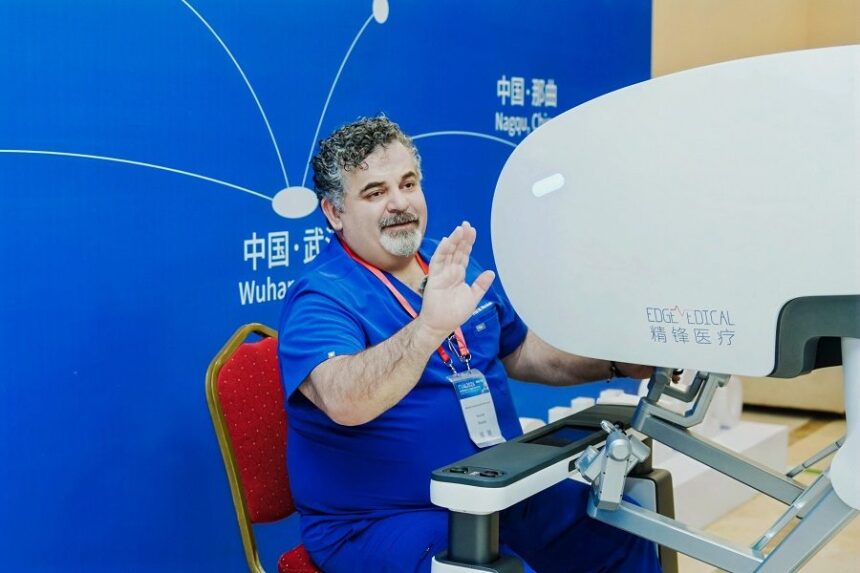
Leading experts in robotic surgery were invited to take part, including Professor Mikhail (Mkrtich) Mosoyan, one of the founders of the robotic surgery school in Russia; Professor Alberto Breda of Spain, president of the European Association of Urology's Robotic Urology Section; Professor Evangelos Liatsikos of Greece; and Professor Jiyu Liu of China.
From Wuhan, Mosoyan controlled the surgical robot and operated on a patient at the Astghik Medical Center in Yerevan. The distance between them exceeded 6,000 kilometers.
This example of telesurgery shows that advances in medical technology involve more than the introduction of new equipment: they are also changing the way medical professionals collaborate. A surgeon is no longer required to be physically beside the patient, but this does not mean that the role of the medical team on site is diminished. The team present in the operating room in Yerevan was responsible for the patient's safety and was ready to take over the procedure if necessary.


This is precisely what distinguishes a successful demonstration from an ordinary technological experiment. Bridging the distance was made possible not only by the robotic system but also by preparatory work and a reliable connection. Mosoyan's participation also demonstrates that such initiatives can bring Armenian doctors into international professional cooperation, regardless of where the leading surgeon is located. At the same time, this single successful case does not yet answer how widely or under what conditions such operations could be performed in everyday medical practice.