




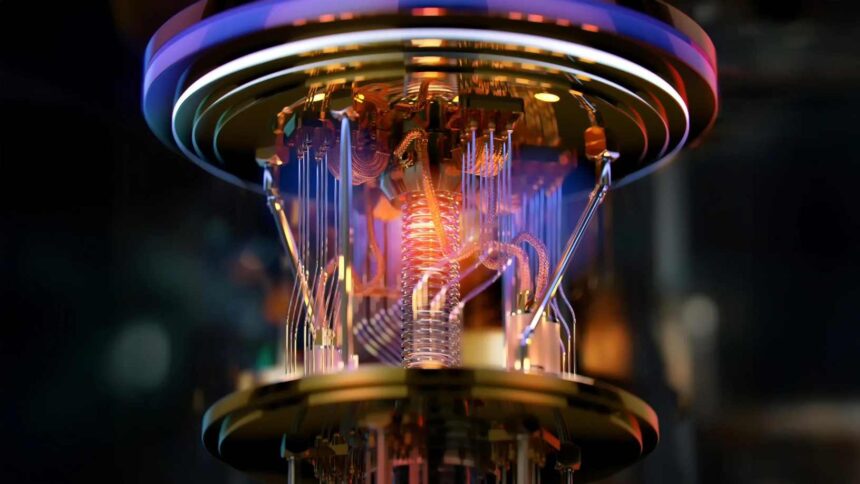
An IBM quantum computer has completed an extraordinarily complex computational task in 15 minutes—one that would take classical computers an unrealistically long time to simulate. Conducted in collaboration with scientists from the University of Chicago, the achievement demonstrates quantum advantage, as researchers also succeeded in statistically proving the accuracy of the obtained results.
Conventional computers operate using bits, which hold a value of either zero or one. Quantum computers use qubits, which can exist in a combination of both states and interact through quantum entanglement. Previously, scientists relied on random circuit sampling, but as calculations grew more complex, verifying their accuracy with classical machines became practically impossible.
To overcome this hurdle, the team from IBM and the University of Chicago developed a new architecture of encoded quantum circuits. It preserves the same computational complexity while simultaneously allowing errors to be detected during the calculation itself. The scientists conducted the experiment using 70 protected logical qubits, marking one of the largest demonstrations of quantum error correction to date.
During the calculation, 2,415 two-qubit operations and 468 logical "T-gate" operations were performed, reducing the error rate by a factor of 10. According to IBM Research Director Jay Gambetta, this establishes a solid foundation for solving complex scientific and industrial problems in the future. The researchers have published the experimental circuits and results on the Quantum Advantage Tracker platform.
For years, the main obstacle in quantum computing was not speed, but trust in the answers generated. When a computer solves a problem that a conventional supercomputer cannot replicate, it is difficult to tell whether the result is accurate or merely the product of technical noise.
This experiment is significant precisely because it unites complex computation and error control within a single system. Although the specific task does not yet solve a practical business problem, it shows that the technology is moving beyond purely theoretical testing. For scientists and companies, this means it will become possible in the future to trust quantum simulations without needing to verify them via classical methods.