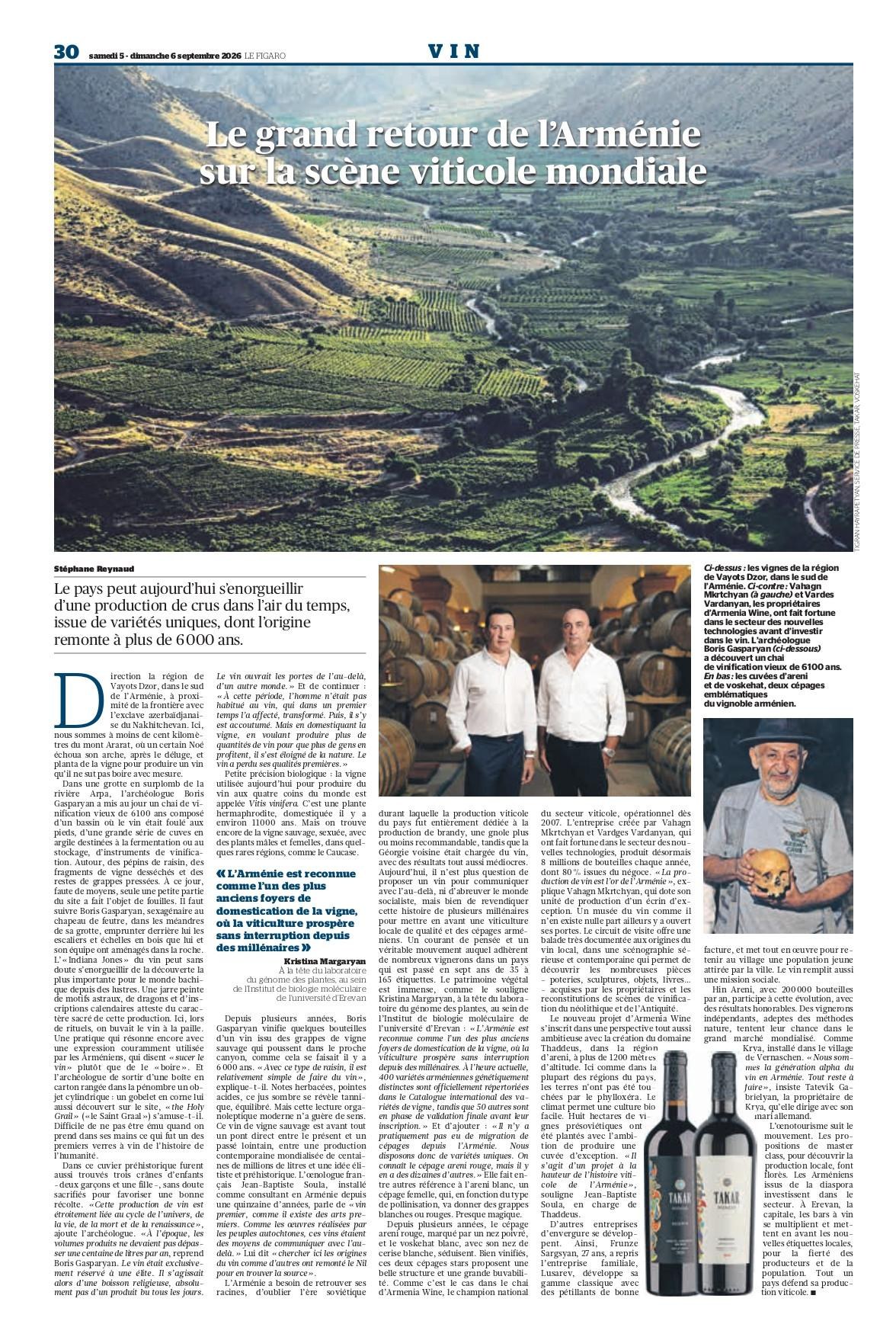


The prestigious French publication Le Figaro has focused on the resurgence of Armenian winemaking in an article titled "Armenia's Great Return to the Global Wine Scene." Journalist Stéphane Reynaud presents Armenia as a country with a millennia-old winemaking history, which is currently transforming its ancient heritage into a significant advantage for modern viticulture.
Special attention is given to the Armenia Wine company, which is highlighted as a leader in the sector. Founded by Vahagn Mkrtchyan and Vardges Vardanyan, both of whom achieved success in the technology industry, the company now produces around 8 million bottles of wine annually. The company has also opened Armenia's first Wine History Museum, which showcases the origins and historical heritage of Armenian winemaking in a modern format.
According to Le Figaro, the development of the sector over the last few years has been truly impressive: in just seven years, the number of Armenian wine labels has grown from 35 to 165. A new generation of producers is focusing on local varieties, quality, and the story of Armenian origin.
All of this relies not only on marketing approaches but also on a serious scientific and historical foundation. There are 400 Armenian grape varieties registered in international catalogs, with another 50 currently in the approval process—a testament to the rich genetic heritage that allows Armenia to distinguish itself on the global market.


Armenia's positioning on the global map is also supported by historical facts. The 6,100-year-old winery discovered in the Areni cave in Vayots Dzor proves that the country is one of the ancient centers of grape domestication. At that time, wine was not just an everyday beverage but held ritual significance and was intended for the elite. Today, the Areni Noir and Voskehat white varieties have become symbols of modern Armenian winemaking.
For Armenia, this oenological renaissance is not just an economic opportunity but a rediscovery of identity. When a country is able to turn a 6,000-year history into a modern business model, it becomes a powerful competitive advantage in an international market where consumers are no longer just looking for a drink, but for a story and a pedigree.



All of this demonstrates that winemaking can become the face of Armenia's agriculture and tourism. The main challenge remains the consistent growth of international recognition, so that unique Armenian grape varieties can move beyond specialized markets and become accessible to a wider global audience. Over the coming years, it will be interesting to observe how this new generation of producers continues to balance ancient traditions with global marketing demands.