


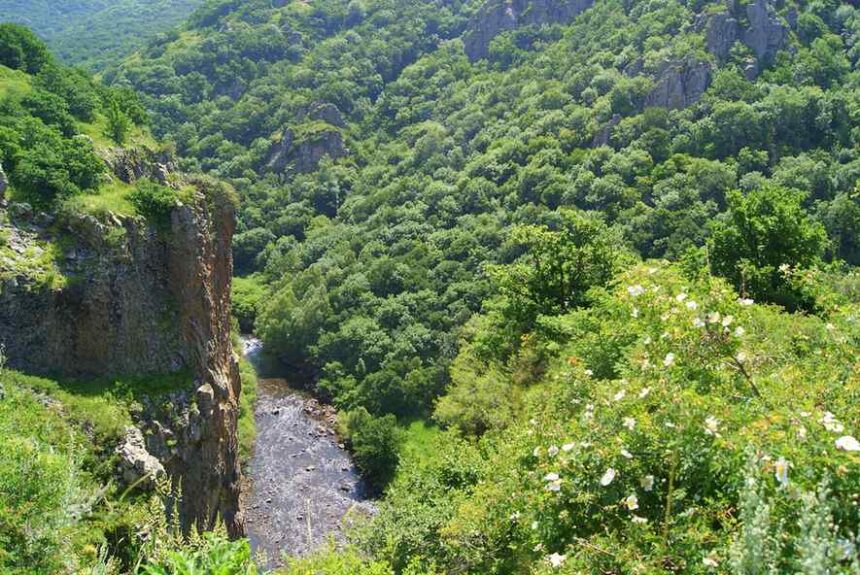
Following the 2020 44-day war, Azerbaijan gradually occupied around 200 square kilometers of Armenia’s sovereign territory, primarily as a result of military operations carried out between 2021 and 2023. Some of the lost territories are specially protected natural areas, including the Jermuk State Hydrological Sanctuary in Vayots Dzor Province.
As a result of Azerbaijan’s September 2022 offensive, approximately 65 square kilometers of territory in Vayots Dzor were occupied, while Armenia lost another 8.5 square kilometers south of Mount Karmrakaratar in Syunik. The territory seized in Vayots Dzor lies entirely within the boundaries of the Jermuk Hydrological Sanctuary. Measurements made using Google Maps indicate that 64.6 square kilometers have been occupied, accounting for 37.2% of the sanctuary’s total area.
The Jermuk Hydrological Sanctuary was established in 2009 to protect the aquatic and surrounding ecosystems, biodiversity, and natural resources of the upper Arpa River basin. It covers an area of 17,371.76 hectares. Three species of invertebrates listed in Armenia’s Red Book are also found there.
The sanctuary is managed by the Environmental Patrol Service of the Ministry of Environment. However, because of the occupied territory and Azerbaijani military positions stationed along it, the service cannot access the entire area. Around 28 kilometers of the sanctuary’s northern and eastern boundaries also coincide with the Armenian-Azerbaijani border.


The mountain peaks of Sartsali (3,433 meters), Dranak (3,396 meters), and Karmrakaratar (3,058 meters) have come under Azerbaijani control. These peaks overlook the surrounding areas, and several left-bank tributaries of the Arpa River originate there. In September 2022, Azerbaijani forces also reached the Arjisari heights, located just 4.4 kilometers from Jermuk’s residential area and offering a vantage point overlooking the city.
The loss of a specially protected natural area is not merely a change in boundaries on a map. In the case of the Jermuk Hydrological Sanctuary, the issue also concerns the upper Arpa River water system, natural springs, and the environment that the state placed under a special protection regime. When more than one-third of an area falls outside Armenia’s control, conservation efforts cannot continue with the same level of effectiveness.


There is also a long-term concern. The plan to establish Jermuk National Park was intended to bring several neighboring protected areas together and ensure their unified management. However, the current situation makes achieving that goal more difficult. Even if the project moves forward in the future, its effectiveness will depend not only on management decisions but also on how much of the territory remains accessible to environmental services. This means that the issue is not simply about establishing a national park; it is also about preserving the integrity of the areas designated for it.