




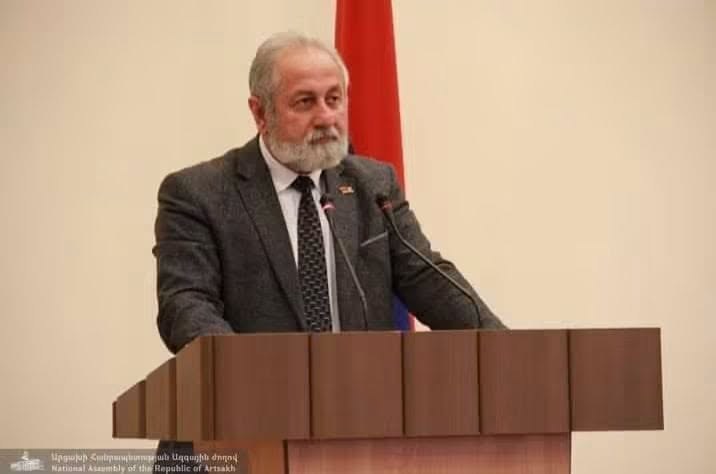
Gagik Bagunts, who is fulfilling the duties of the President of the National Assembly of the Republic of Artsakh, has issued a message on the anniversary of the September 27, 2020 war.
Six years ago, on September 27, 2020, Azerbaijan grossly violated the fundamental principle of conflict settlement—the non-use of force and the threat of force—as well as its international obligations to resolve the issue exclusively by peaceful means, and unleashed a large-scale and bloody war against the people of Artsakh.
For 44 days, the entire Armenian nation fought with a united front to guarantee its inalienable right to live and create in its historic homeland, demonstrating unwavering will and heroic resistance. Bagunts today expresses his deep respect and gratitude to the bright memory of all the martyrs who sacrificed their lives for the defense of the homeland, noting that their feat and self-sacrifice are forever imprinted in the history of the nation.
The 2020 war and the numerous military crimes committed by Azerbaijan during it, the targeting of civilian population and infrastructure, never received an adequate, principled and legally commensurate assessment from the international community. It was precisely this impunity and international indifference, according to the message, that became fertile ground for the subsequent blockade, new aggression and ultimately the complete ethnic cleansing of the Armenians of Artsakh.

With the forced displacement and deprivation of the homeland of the people of Artsakh, however, the chain of Azerbaijani crimes was not interrupted. Today as well, Azerbaijan continues to consistently erase the Armenian trace from occupied Artsakh: at the state level, the centuries-old historical, cultural and spiritual heritage is being destroyed, desecrated and distorted, homes and hearths are being razed to the ground, cemeteries and shrines are being desecrated.
Under these circumstances, the protection of Artsakh's cultural heritage, the immediate release of compatriots illegally held in Baku's prisons, and the clarification of the fates of the missing must remain non-negotiable priorities on the national agenda.



What happened in 2020 is not at all a finished story today. The issue of the rights of people forcibly displaced from Artsakh, the fate of Armenians held in Baku's prisons, and the facts of the destruction of cultural heritage continue to remain on the agenda, but interest in them in international forums has significantly decreased. This is a serious problem, because without justice and accountability there can be no sustainable peace.
It is noteworthy that six years later, even the most important humanitarian issues—the search for the missing, the release of prisoners—remain unresolved. The attention of international bodies in the region has shifted to other problems, and this is an objective reality that must be reckoned with. However, this does not mean that these issues have lost their importance or that they should be consigned to oblivion.
In the coming months, two things are worth watching: whether discussions on the destruction of Artsakh's cultural heritage will resume in international forums, and whether there will be tangible progress on the issue of prisoners and the missing. For now, the answer to both is negative.