



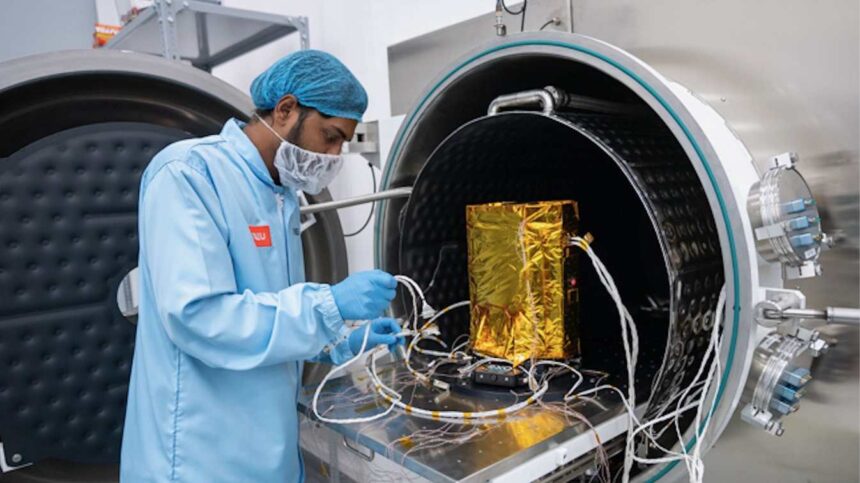
The United Arab Emirates has unveiled a prototype of the lander for its new interplanetary mission, which is set to explore seven asteroids between Mars and Jupiter over the course of eight years. The spacecraft is scheduled to launch from Japan in March 2028 and travel approximately 5 billion kilometers. This marks the country's second major interplanetary initiative.
The primary spacecraft, named the MBR Explorer, will utilize the gravitational assists of Venus, Earth, and Mars along its journey, allowing it to approach the designated asteroids at high speeds and travel into deep space. The mission's primary target is asteroid 269 Justitia, which the spacecraft will reach in 2036. This celestial body stands out due to its deep red hue. Scientists hypothesize that it formed in the most distant, icy regions of the Solar System and only later migrated to the main asteroid belt. Hydrated minerals and organic compounds may be preserved on Justitia.
After spending seven months in orbit, a small lander will separate from the main spacecraft. It will impact the surface at a speed of 15 to 27 meters per second, as it does not possess a braking system. The lander will operate fully autonomously using artificial intelligence and will capture images of the surface prior to impact. Specialists note that if the three-week launch window in March 2028 is missed, the next similar opportunity will not occur for another 100 years.
The three-week launch window leaves virtually no margin for error for engineers. This strict orbital mechanics calculation illustrates how complex and reliant such missions are on planetary alignments. If the launch does not take place in the spring of 2028, the program will effectively be closed for our generation.
Also noteworthy is the spacecraft's collision scenario itself. The lander will not make a soft landing, but will instead directly impact the asteroid—a deliberate tactic chosen to expose unseen subsurface layers. The primary challenge remains whether the equipment will manage to transmit the crucial, final-minute data back to Earth intact.