




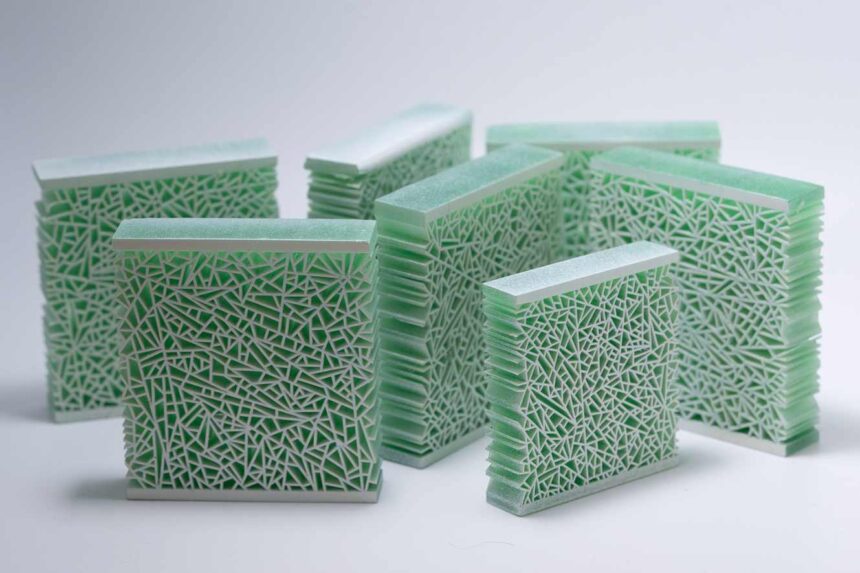
Scientists from the Massachusetts Institute of Technology (MIT) and Northeastern University have developed a new type of material that can better withstand impacts and allow its stiffness and mechanical properties to be precisely controlled. Rather than relying on repetitive, regular structures, these materials are built from complex networks of elements of different sizes.
The new materials are called "multiscale metamaterials." Their structures are inspired by networks found in nature, including leaf veins and the structure of dragonfly wings, as well as connections in social networks. The findings were published in the journal Nature.
Conventional metamaterials are built by repeating a single small element to create regular patterns. In the new approach, scientists used small struts of varying thicknesses and lengths, which connect to form a dense network. This structure prevents damage to one part of the material from causing the entire structure to lose its strength at once.
The researchers developed an algorithm that creates an optimized network from struts of different sizes, depending on the desired properties of the material. They then used 3D printing to produce test samples and compared them with metamaterials featuring conventional lattice and honeycomb structures. Experiments showed that the new materials are more resistant to compression and impacts and can also protect fragile objects placed inside them.

This approach could be used to develop impact-absorbing helmets and armor, as well as materials capable of focusing sound waves and vibrations.
What makes this work distinctive is that the scientists changed not simply the composition of the material, but the way forces are distributed within it. In regular structures, damage to one section can affect neighboring elements of the same type, whereas in the new network, struts of different sizes and thicknesses spread the energy of an impact across a larger area. This offers a different approach to improving material durability.


From a practical perspective, it is particularly interesting that the same design method can produce structures with different levels of stiffness by changing just two key parameters. However, the results obtained from the tested samples do not automatically mean that these materials are ready for widespread use. The next important step will be to determine how they perform under real-world conditions and how efficiently objects of different sizes and intended uses can be manufactured.