




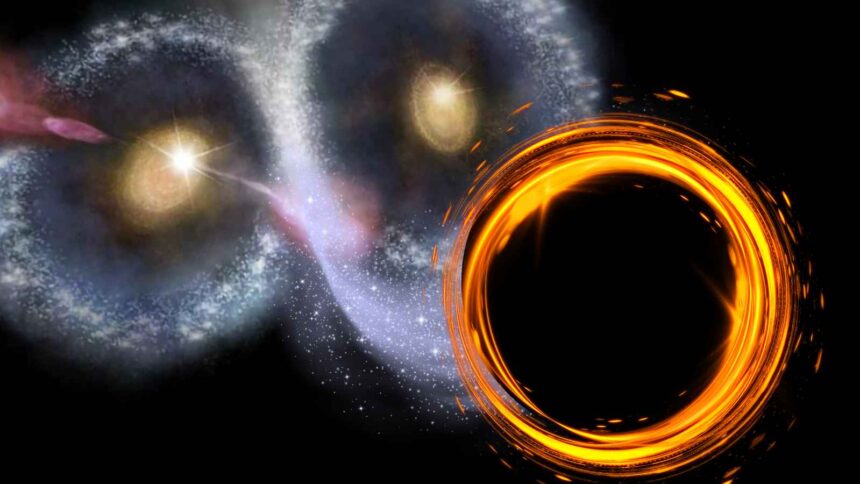
Using the James Webb Space Telescope, astronomers have confirmed the existence of the first-ever runaway supermassive black hole. It is 10 million times more massive than the Sun and is traveling through space at approximately 3.6 million kilometers per hour, covering 1,000 kilometers per second. It is one of the fastest-moving objects ever discovered in the universe.
The black hole is moving through its former galaxy at approximately 3,000 times the speed of sound, pushing a massive shock wave of material ahead of it while leaving behind a 200,000-light-year-long trail of gas. New stars are forming within this gas. Scientists estimate that their combined mass reaches approximately 100 million solar masses.
Researchers first noticed signs of the black hole's existence in 2023, based on data from the Hubble Space Telescope, but the evidence was insufficient at the time. Now, observations from James Webb have confirmed that a black hole is indeed located at the end of the trail, rapidly moving away from its former galaxy and now approximately 230,000 light-years from its original position.
Scientists believe the black hole may have been ejected from its galaxy through one of two mechanisms. In the first scenario, when two galaxies merge, their central black holes eventually combine, and the resulting gravitational waves give the newly formed black hole a powerful kick. In the second scenario, interactions between three black holes destabilize the system, causing one of them to be ejected. Researchers believe the first mechanism was responsible in this case.


Such ejections may occur more frequently because galaxy collisions and mergers are common events. However, it is still unclear how often pairs of black holes merge and how many of them are ejected from their galaxies. Researchers plan to search for additional examples.
The discovery has also shown that such black holes can create entire chains of stars in their wake. The research team's findings have been submitted to The Astrophysical Journal Letters, while a preprint is available on the arXiv platform.


One of the most fascinating aspects of this discovery is that the black hole has not simply moved away from its galaxy: its motion is actively transforming the region through which it travels. The compression of gas creates conditions for new stars to form, meaning that star formation takes place far beyond the galaxy, in an environment that was not previously associated with this kind of phenomenon.
Another important question concerns how common these objects are. If galaxy mergers occur frequently, interactions between the black holes at their centers could also regularly produce similar outcomes. However, theoretical calculations alone cannot establish how often black holes are actually ejected. This is where the confirmation becomes significant: scientists can now search for other examples and compare their observations to determine how widespread the phenomenon is. New wide-field images with a quality comparable to Hubble's, including future data from the Nancy Grace Roman Space Telescope, could make this search considerably easier.