



Physicists have created an unusual quantum state of matter that combines two seemingly contradictory properties: it has an ordered structure like a crystal while flowing without friction like a superfluid. Known as a supersolid state, it had previously been observed only under highly restrictive conditions, mainly in systems involving weakly interacting particles.
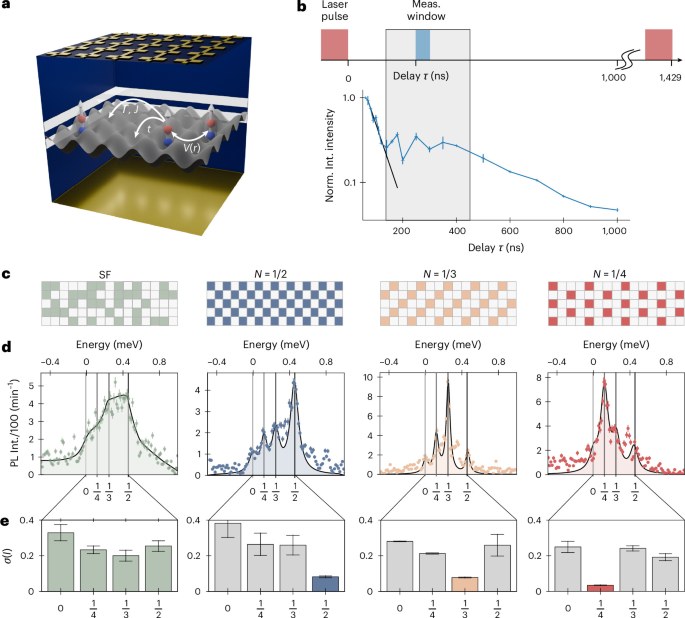
In a new study, scientists have demonstrated how such a state can be achieved under conditions of strong interactions by placing dipolar bosons in a lattice structure, where particles can interact over long distances and move around. Experiments have shown that dipolar excitons, quasiparticles that form in semiconductors, can create such a system.
At one-quarter, one-third and one-half filling of the particle lattice, the researchers observed quantum crystals spanning approximately 100 sites. Their structure spontaneously breaks the lattice's translational symmetry, meaning that particles arrange themselves in a specific pattern. At the same time, long-range quantum coherence between particles allows the system to flow without friction, like a superfluid.
Numerical calculations also confirmed that both properties emerge in the system's ground quantum state. The findings were published in the journal Nature Physics on November 25, 2026.


What makes this result particularly significant is that the researchers observed the supersolid state under conditions of strong interactions rather than weak ones. This expands the range of physical conditions in which such states of matter can be studied. Observing a structure spanning approximately 100 sites is also important, as the researchers are dealing not with isolated particles but with a spatially organized quantum system.
Dipolar excitons play a particularly important role in the study, making it possible to combine lattice order with long-range quantum coherence. The simultaneous presence of these two properties is a defining characteristic of the theoretically predicted supersolid state. An important next question is how effectively the properties of such systems can be controlled and investigated under different conditions.