




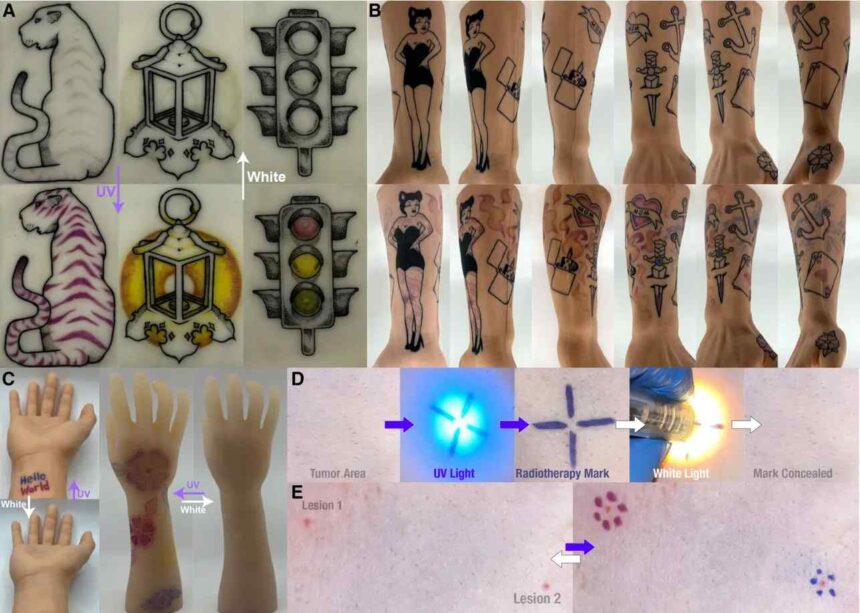
Scientists have developed tattoo ink whose color can be changed using light, making the design almost invisible when needed. The PhotoTat technology, developed by researchers at the University of Colorado Boulder, could eventually benefit both tattoo enthusiasts and medical professionals who need to mark specific areas of the skin for medical purposes.
The technology is based on photochromic dyes, which change color when exposed to light of a specific wavelength. The scientists encapsulated three dyes in transparent microscopic capsules made of polymethyl methacrylate, each measuring a few hundred nanometers. Under normal lighting conditions, the dyes are almost colorless, but exposure to ultraviolet light at a wavelength of 365 nanometers makes them develop vivid colors.
Just two to three seconds of intense light is enough to activate or deactivate the dyes. By mixing three primary colors—blue, magenta, and yellow—in different proportions, the researchers produced 16 distinguishable colors and at least 300 shades. They created the designs using stencils, directed ultraviolet light, and a laser projector, conducting experiments on silicone models and samples of pig skin. White light can make the design invisible, while light of a specific wavelength can switch off individual colors. Without further exposure, the dyes gradually lose their color over several hours.
Carson Bruns, an associate professor at the university and the study's lead researcher, has already tested the technology on his own legs, tattooing them with colorful scale-like patterns. According to the scientists, the dyes continued to respond to light 1.4–2.2 years later. No obvious fading or known side effects were observed, but testing on a single person is not enough to establish the technology's safety for the general public.


The technology's most promising application may lie not in tattoo fashion but in addressing the challenges of medical marking. During radiation therapy, doctors need to determine the precise direction of radiation, while marks left on the skin may no longer be necessary once treatment is complete. If these marks could be made visible only when needed, and this could be done safely, the technology would solve a practical problem without requiring permanent markings.
However, there is still a considerable gap between laboratory success and everyday use. Testing on one person cannot establish how different people's skin and bodies will respond to the ink over long-term use. In addition, exposure to sunlight and the gradual degradation of the dyes indicate that the technology still needs improvement. Before it can be widely adopted, researchers must test not only the stability of its colors but also the safety of the finished formulation.