


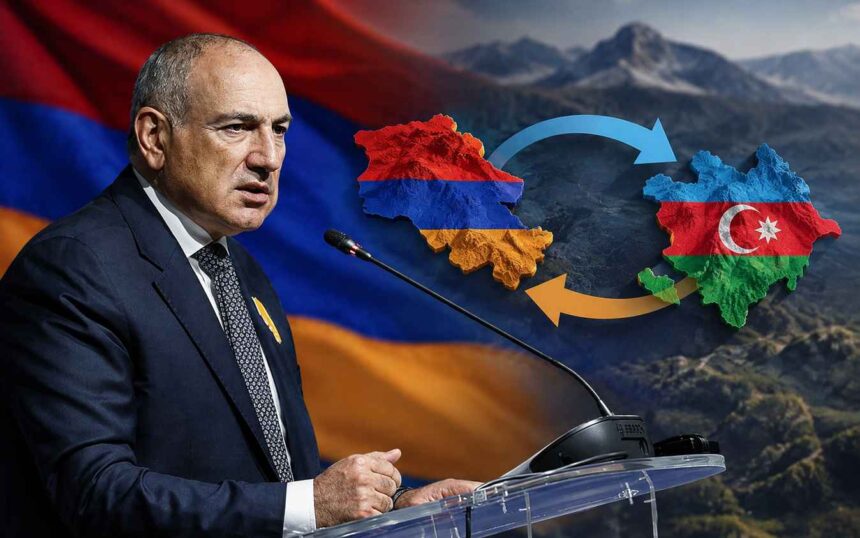
In a video address, Armenian Prime Minister Nikol Pashinyan outlined what peace between Armenia and Azerbaijan should look like after the peace agreement is signed and ratified.
According to Pashinyan, Armenia's territory should cover 29,743 square kilometers, while the delimitation and demarcation of the borders should be carried out on the basis of the Alma-Ata Declaration, following this approach.
The issue of enclaves and exclaves, Pashinyan said, should be resolved in such a way that neither side of the border has any. To achieve this, Armenia and Azerbaijan should exchange territories of precisely equivalent size.
Pashinyan also noted that all roads and communication routes should be open, not only those covered by the TRIPP project. They should also ensure Armenia's connection with other parts of its territory through Azerbaijan, as well as Azerbaijan's connection between different parts of its own territory through Armenia.

Another principle outlined by the prime minister is that the two countries should have no claims against each other and should leave each other alone on all issues. In this context, he mentioned Karabakh, Gardman, Shirvan, Nakhichevan, and the term “Western Azerbaijan.”
Pashinyan also spoke about the realistic possibility of achieving peace through this approach. He said that, following his contacts with the Azerbaijani president in Turkmenistan, he had gained an initial impression that such peace was achievable, and that they would work in the coming period to turn this possibility into reality.


The approach presented by Pashinyan links the issue of peace not only to the signing of an agreement but also to the practical resolution of border, territorial, and communication-route issues. These points are interconnected: resolving border disputes and opening roads require clear arrangements, the implementation details of which were not fully presented in the video address.
Particular attention should be paid to the proposal to exchange enclaves and exclaves, as it concerns territories of precisely equivalent size. At the same time, the principle of keeping roads open implies communication routes passing through the territories of both countries, while the approach of renouncing mutual claims also concerns historically and politically sensitive issues. Following his contacts in Turkmenistan, Pashinyan expressed initial optimism, but this does not yet confirm a final agreement or the implementation of any arrangements.