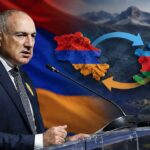



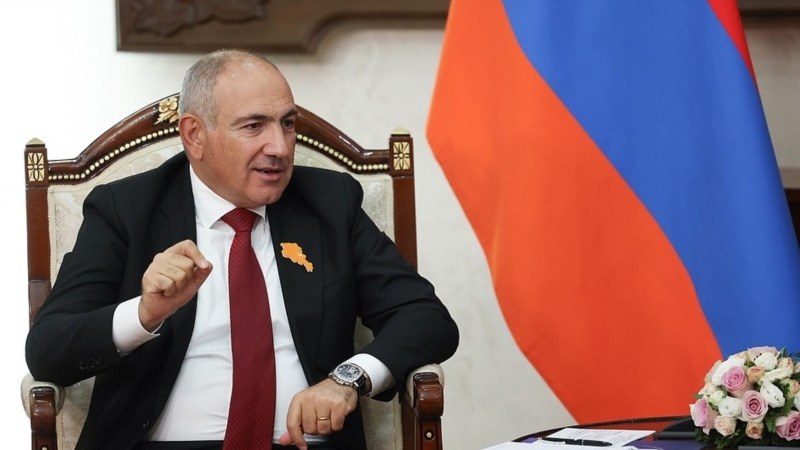
Prime Minister Nikol Pashinyan has said that the issue of enclaves and exclaves between Armenia and Azerbaijan should be resolved through an exchange of territories. In a video address today outlining his vision for peace, he said he had gained a preliminary impression that such an arrangement was feasible following his contacts with Azerbaijani President Ilham Aliyev in Turkmenistan.
"There should be no enclaves or exclaves on either side of the border, meaning that the two countries should exchange territories of precisely corresponding sizes," Pashinyan said. He reiterated that Armenia's territory should cover 29,743 square kilometers and that the delimitation and demarcation of the border should be carried out on the basis of the Alma-Ata Declaration.
"I have a preliminary impression that we have an opportunity to give peace this kind of shape, and in the coming period, we will be working to turn that opportunity into reality," the prime minister said.
Pashinyan also addressed the issue of mutual territorial claims between the two countries, saying that both sides should abandon such claims and make no demands against each other. According to him, this also applies to claims framed in terms of Karabakh, Gardman, Shirvan, Nakhichevan or "Western Azerbaijan."


At the same time, Baku continues to insist that Armenia must amend its Constitution before signing a peace agreement. The Azerbaijani side considers the reference to the Declaration of Independence in the Constitution's preamble to be an expression of territorial claims against Azerbaijan. Yerevan rejects this interpretation, but Pashinyan's government is now drafting a new Constitution, and the date of the referendum on it remains unknown.
It remains unclear from Pashinyan's statement today whether he was also referring to constitutional changes when he spoke about the possibility of implementing his vision for peace. The previous day, the ruling Civil Contract party held a meeting. Judging by the published video, which had no sound, one of the topics discussed was also the new Constitution.

In Pashinyan's proposed approach, the exchange of territories and the renunciation of mutual territorial claims are the two main components of his vision for peace. However, a political statement does not mean that the parties have reached an agreement on specific terms. Discussing the precise size of the territories also does not, in itself, answer the question of how the territories to be exchanged will be determined or what procedure will govern the process.
The constitutional issue remains another key sticking point. Baku links a constitutional amendment to the signing of a peace agreement, while Yerevan does not accept that the current Constitution contains territorial claims. The drafting of a new Constitution adds further political significance to the debate, but the lack of clear information about the referendum timetable and the planned amendments still makes it difficult to determine how the process will be linked to peace negotiations.