




Paleontologists have discovered a new species of predatory dinosaur by studying a fossil that had been kept at London’s Natural History Museum for nearly a century without receiving proper attention. The study was published in the scientific journal Royal Society Open Science.
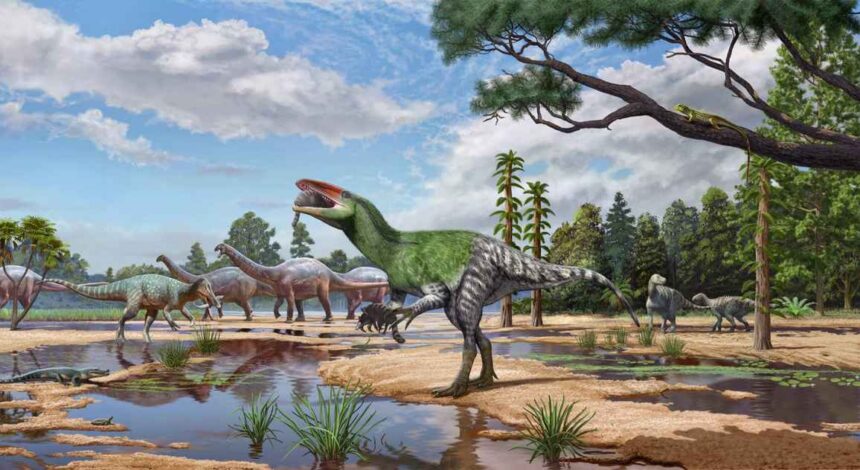
The dinosaur, named Invictibellatrix amberina, lived in what is now the United Kingdom around 120 million years ago. It was about the size of a large tiger, had long, curved claws, and became the first member of the megaraptor group to be identified from a fossil found in Europe. The first part of its name means “unconquered female warrior,” reflecting the image of these predators, which later became some of the dominant hunters in their ecosystems.
The fossil was discovered by amateur paleontologist Reginald Walter Hooley at the foot of a cliff on the southwestern coast of the Isle of Wight. Many of his finds were later transferred to the museum, and a fragment of the rear portion of this dinosaur’s skull was acquired for the collection as early as 1924. However, its true significance has only now come to light.
Scientists estimate that the dinosaur was three to four meters long and slightly more than one and a half meters tall. Its body was probably covered in feathers, and some of its claws reached 10–20 centimeters in length. It hunted small dinosaurs, lizards, and mammals. The study’s lead author, Cassius Morrison of University College London, compared its ecological role to that of a modern hyena, noting that the predator could also have posed a danger to humans.
Megaraptors were related to tyrannosaurs, including Tyrannosaurus rex, but had narrower skulls and powerful forelimbs. They probably made active use of their long claws when hunting rather than relying solely on the strength of their jaws.
The discovery shows that reconstructing the distribution of ancient animals depends not only on new excavations but also on re-examining fossils that have already been found. The specimen kept in a museum for nearly a century has provided new information about the geographical distribution of megaraptors and helped fill a gap that had previously made it difficult to test theories about their possible route toward the southern continents.


At the same time, a single find does not answer every question. Modeling suggests a possible pattern of the group’s dispersal, but the reasons for megaraptors’ disappearance from northern regions remain unclear. Climate change and competition with other predators are possible explanations, not established conclusions. Further research may also clarify when and under what conditions these animals spread across different continents.