



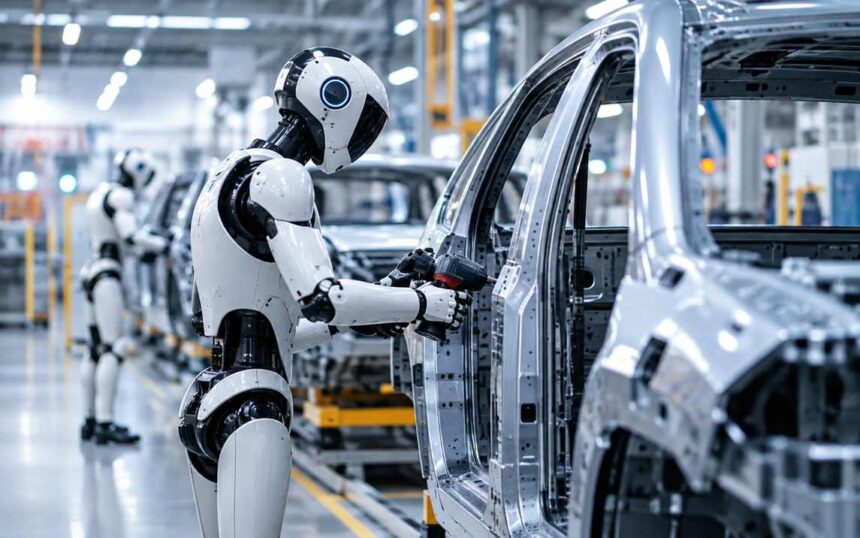
An auto parts manufacturing enterprise in the city of Hangzhou, Zhejiang Province, China, has put about 20 humanoid robots into operation, handling loading and unloading work on the production line. Chinese news sources reported this on October 13, publishing photographs taken at the factory.
The company deployed the robots on the production line based on its own production capacities and computing resources; before that, the humanoid machines had undergone more than 10,000 trial cycles. Currently, the production takt time for loading and unloading operations is 20-25 seconds.
The photographs show how the humanoid robots, using mechanical arms, precisely place auto parts at workstations on the production line, as well as how they grasp the components to be delivered to the line. In several frames, it is visible that when an empty spot appears in a section of the line, the robot fills in the missing part with its mechanical arm, while two humanoid robots work simultaneously at the beginning of the production line.
The robots use special mechanical arms adapted for auto parts, which allows the components to be placed precisely without additional intervention.



This is one of those cases where industrial automation ceases to be a theoretical discussion and becomes a concrete factory reality. The 20-25 second takt time does not say much to an ordinary reader, but in manufacturing it is a fairly aggressive indicator — especially when the subject is humanoid robots, not conventional industrial manipulators.
What is noteworthy here is not the mere fact that the robots "work," but that the company deployed them not on a new line designed specifically for robots, but on an already existing production line — after 10,000 trial cycles. It is precisely this detail that shows the technology is gradually adapting to the real factory environment, and not the other way around.


The question that still has no answer is what will happen to the people working on that line, and whether this is an isolated experiment or the first sign of a broader shift expected in the coming years.