




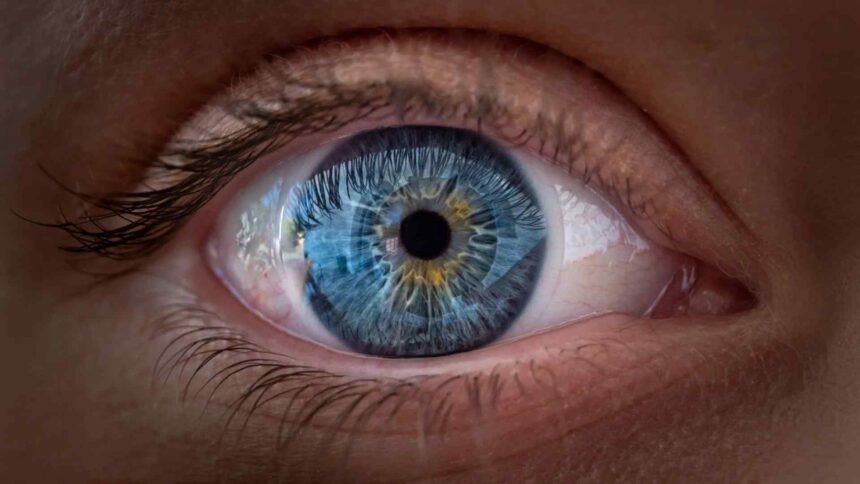
Scientists at Johns Hopkins University have discovered how retinoic acid, a substance derived from vitamin A, works alongside thyroid hormones to help form the part of the human eye responsible for the sharpest vision. The discovery offers a new explanation for a process that scientists have understood differently for nearly 30 years.
The research focused on the foveola, located at the center of the retina. It helps people see fine details clearly, read and recognize faces. Although this area makes up only a very small part of the retina, researchers estimate that it accounts for about 50 percent of human visual perception.
Scientists found that during weeks 10–12 of fetal development, the foveola initially contains cells that detect blue light. However, by week 14, some of these cells transform into cells that detect red and green light. Two substances are involved in this change. Retinoic acid, which is derived from vitamin A, limits the formation of blue-light receptors in the central region, while thyroid hormones help the remaining cells develop into red- and green-light receptors.
The discovery challenges a theory that had been widely accepted for nearly 30 years: that blue-light receptors simply move away from the foveola during development while retaining their original identity. The new findings indicate that some cells may change their specialization. However, scientists do not rule out the possibility that cells also migrate to other areas.


To conduct the study, the team created miniature models of the human retina in the laboratory, known as organoids, which allowed them to monitor tissue development over several months. The findings were published in the journal Proceedings of the National Academy of Sciences.
The discovery could eventually help researchers develop new approaches to treating macular degeneration and other diseases that cause vision loss. Scientists are now working to improve retinal organoids so they can use them to produce light-sensitive cells in the laboratory and potentially transplant them into damaged retinas in the future. This technology is still in the research stage and requires additional testing to establish its safety and effectiveness.



Scientists also emphasize that the discovery concerns eye development before birth and does not prove that taking vitamin A supplements can improve vision in adults.
One of the most interesting aspects of this research is that scientists have not only identified the role of substances involved in eye development but have also reconsidered a long-standing understanding of how cells behave. While the previous assumption was that blue-light receptors simply move away from the center of the retina, researchers are now also considering the possibility that these cells transform into other types of cells. This changes the questions scientists need to ask when studying how human vision develops.
The medical significance of this work is particularly evident in its potential future applications. Producing tissues resembling the human retina in the laboratory could help pave the way for new methods of replacing damaged cells, but there is still a long way to go. Researchers must ensure that transplanted cells not only survive but also connect properly to the eye's functioning system and operate safely. Therefore, this discovery is not yet a ready-to-use treatment, but rather a foundation for further research.