



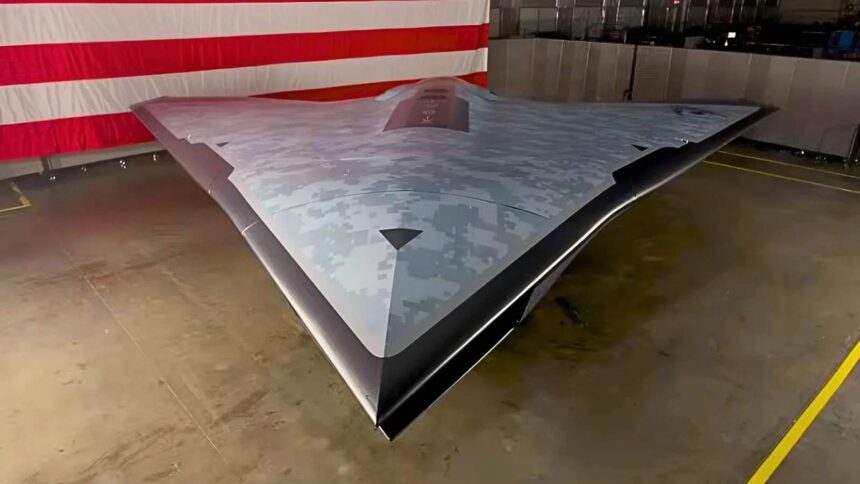
The American company Shield AI has completed the construction of the first full-scale prototype of the X-BAT unmanned combat aircraft, capable of vertical takeoff and landing. The developers are now preparing the device for testing, during which the operation of the powerplant and the ability to fly without the use of conventional runways must be verified.
The prototype, designated X-BAT 001, has been rolled out of the company's plant in Frisco, Texas, and is now being transported to the X-Forge 2 test site in Kansas. The checks will be carried out in stages: first, engineers will test the engine in a horizontal position, then they will verify its operation during vertical flight. After that, crane-assisted captive tests will begin, so that in the event of possible technical failures the risk of damaging the device is reduced. If these tests are successful, the developers will move on to free flights without a supporting harness.
The X-BAT is equipped with a GE Aerospace-produced F110-GE-129E turbofan engine, while a rotating exhaust nozzle makes it possible to direct the exhaust gas flow to control the aircraft's position during vertical maneuvers. In July, the companies completed tests of engine start-up, nozzle movement and the integration of those systems.
Shield AI plans to use the X-BAT for strikes against ground targets, aerial combat and electronic warfare. The aircraft will be able to carry armament in internal bays and on external hardpoints; according to the developer, the internal bays are designed for munitions weighing up to 907 kg. Flight and mission execution are to be controlled by the Hivemind autonomous system developed by Shield AI, designed to operate in conditions where GPS satellite navigation or communications become unreliable.
The company states that the flight range with a full combat load exceeds 3,700 km, while the combat radius is about 1,850 km. These characteristics still have to be confirmed by testing.
According to the developers' concept, the main advantage of the X-BAT is its ability to operate independently of conventional airfields, which will allow the device to be used from ships, remote islands and other platforms with limited infrastructure. However, for now the talk is about a prototype: the timing of the first independent flight and the aircraft's real combat capabilities remain to be determined.


The most noteworthy thing in the X-BAT story is not the flight itself, but the stage at which the testing begins. Crane-assisted holding shows how carefully the developers are treating the first independent flight: this is a prototype worth millions of dollars, where any failure could prove costly.
Also noteworthy is that the company is already announcing a range of 3,700 km and 907 kg of munitions, while those figures have not yet been confirmed by testing. This is a common approach in the new technology market: the best performance figures are presented in advance, and the real picture becomes clear later.
And the most important question, which still has no answer, is when the X-BAT will make its first independent flight and whether it will be able to justify the hopes placed in it. Until then, all that remains is to follow the progress of the testing.