



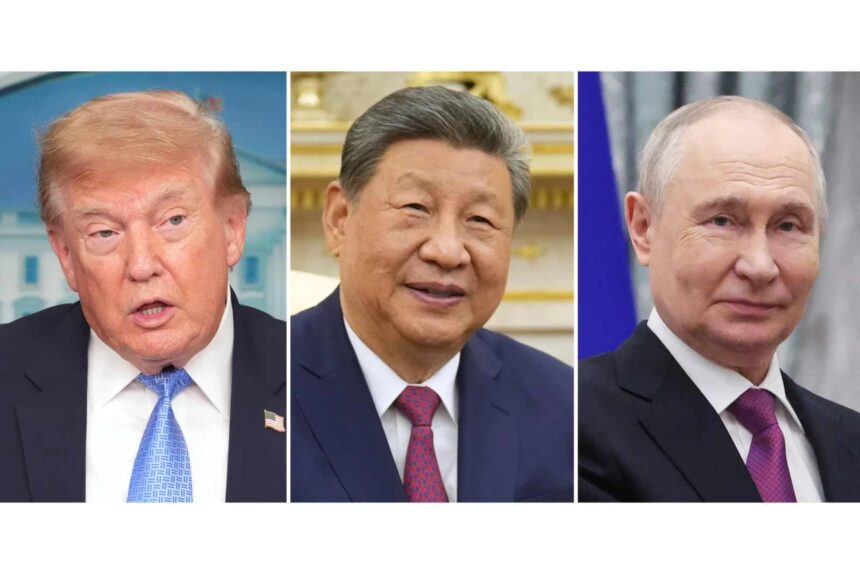
US President Donald Trump, Chinese President Xi Jinping and Russian President Vladimir Putin are planning to hold their first-ever joint meeting in Shenzhen, China, on the sidelines of the Asia-Pacific Economic Cooperation (APEC) summit. The White House has announced the plans for the meeting.
The main topic of the talks will be reducing nuclear arsenals. Trump also intends to discuss the US war against Iran with the Russian and Chinese leaders.
According to a senior US official, Ukraine will not be on the agenda. However, the White House does not expect any immediate agreements to emerge from the meeting and views it as the beginning of a dialogue on nuclear disarmament.
The last treaty limiting strategic nuclear weapons between the United States and Russia, the Strategic Arms Reduction Treaty (New START), expired in February. Before that, Trump rejected Moscow's proposal to extend the agreement for another year, saying that a new treaty involving China was needed.
According to Pentagon estimates, China has more than 600 nuclear warheads, while the United States and Russia each have more than 5,000. Beijing has so far shown little interest in signing an agreement to limit nuclear arsenals.
The main challenge facing this meeting is not getting the three leaders around the negotiating table, but finding common ground for a possible agreement. The United States and Russia no longer have an active treaty limiting strategic nuclear weapons, while China has so far shown no interest in such an agreement. This means the talks are beginning without clear indications that all three sides are willing to reach a deal.



Trump's proposed new framework would require China to take part in joint arrangements on nuclear arms control. However, the differences in the size of the three countries' nuclear arsenals make it difficult to establish mutually acceptable terms. Therefore, even if the meeting does not produce an agreement, the positions expressed by the parties could indicate whether there is a genuine basis for trilateral dialogue on nuclear disarmament.