




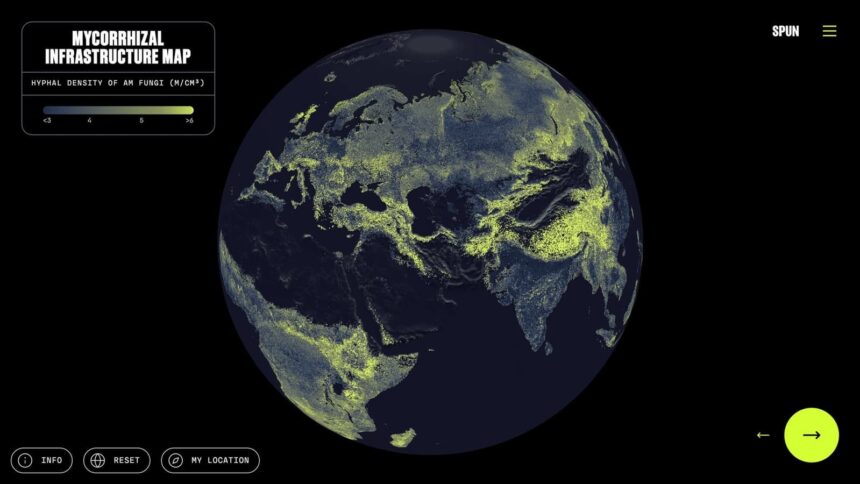
Beneath Earth's surface lies a vast underground fungal network whose scale had not been quantitatively assessed until now. An international team of scientists has for the first time created a global map of this system, revealing that the total length of mycorrhizal fungal structures could reach approximately 110 quadrillion kilometers. The work was published in the journal Science.
This refers to arbuscular mycorrhizal (AM) fungi, a group of soil fungi that form a symbiosis with plant roots. Their delicate threads, called hyphae, penetrate the soil and facilitate nutrient exchange: the fungi transfer water and mineral elements to plants, and in return receive carbon produced during photosynthesis. This type of interaction is fundamental for terrestrial ecosystems; estimates suggest that about 70% of all plant species depend on mycorrhizal connections for normal growth and survival.
Despite the crucial role these fungi play in the functioning of ecosystems, there has been no quantitative global assessment of their distribution until now. Previous work primarily focused on the diversity of microbial communities in the soil but did not allow for the reconstruction of the entire network's density and geographical structure.