



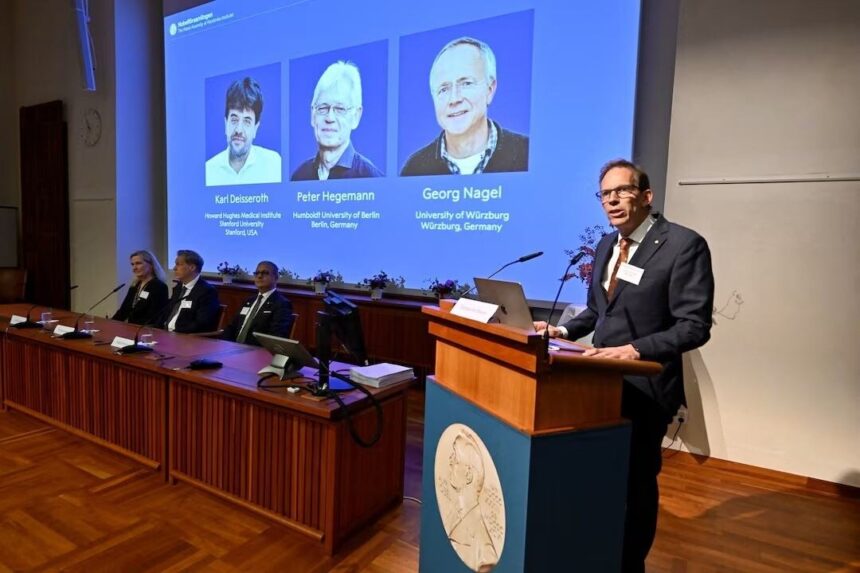
Karl Deisseroth, Peter Hegemann and Georg Nagel have been awarded the 2026 Nobel Prize in Physiology or Medicine for their “discoveries concerning light-controlled ion channels and optogenetics.” The prize was announced on October 5.
The 54-year-old American Karl Deisseroth, 71-year-old German Peter Hegemann and 73-year-old German Georg Nagel will receive 12 million Swedish kronor, about $1.2 million, which is divided among the laureates when there is more than one recipient.
According to the Nobel Committee, optogenetics makes it possible to switch the activity of individual nerve cells on or off in a living brain. The method is now used in laboratories around the world to study the mysteries of how the brain works.
Hegemann and Nagel discovered the key protein in a single-celled alga, while Deisseroth turned it into a light-controlled “switch” for nerve cells. According to the Nobel Committee, these discoveries laid the foundation for a new era in neuroscience.
For a long time, scientists tried to understand how the brain controls emotions, behavior and bodily functions, but earlier methods did not allow them to establish causal links between them. Optogenetics has changed these possibilities, allowing brain activity to be studied at a more precise level.
The Nobel Prize in Physiology or Medicine traditionally marks the beginning of the annual series of Nobel Prize announcements. In the coming days, laureates in physics, chemistry, literature, peace and economics will also be announced.


What makes these discoveries distinctive is that they not only provided neuroscience with a new tool, but also changed the approach to studying the brain by making it possible to isolate the activity of specific nerve cells and observe its connection to behavior and bodily functions.
The significance of the laureates’ work is particularly evident from the fact that optogenetics is already being used in laboratories around the world. In other words, the prize was awarded not only for a fundamental scientific discovery, but also for a method that continues to expand our knowledge of the brain today.
A distinctive aspect of this prize is that it is not only about new knowledge of how the brain works. Optogenetics has given scientists a tool that makes it possible to study the role of individual nerve cells more precisely and understand how their activity is linked to brain functions. This capability is particularly important because earlier methods often did not provide the same level of ability to establish causal relationships.
At the same time, the facts presented in the article show that the discovery has already moved beyond the boundaries of theoretical science. The method is being used in laboratories around the world, while the work underlying it connects the study of a single-celled alga with the possibility of controlling nerve cells with light.