



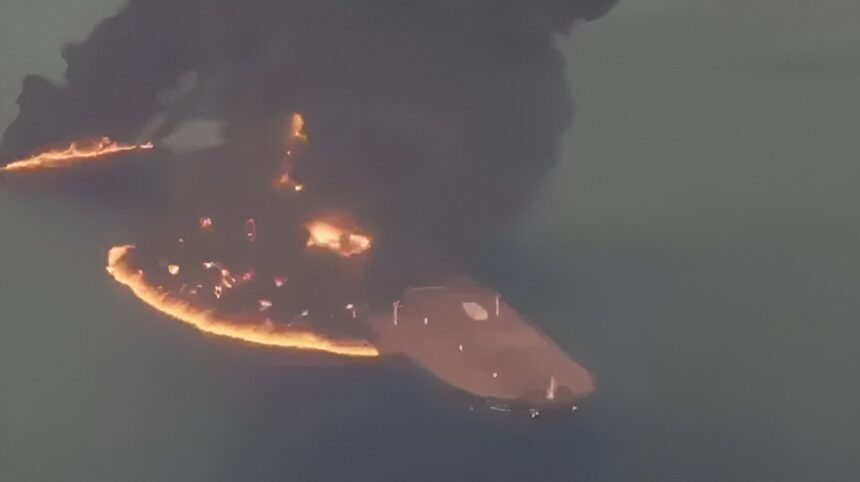
A powerful explosion has occurred aboard a tanker carrying more than 2 million barrels of crude oil in the Strait of Hormuz, followed by a major fire. The naval forces of Iran's Islamic Revolutionary Guard Corps (IRGC) have stated that the vessel struck a naval mine, which caused the explosion.
According to IRGC representatives, the tanker attempted to pass through the strait along an "unauthorized route," having previously switched off its location — positioning — systems. Iranian media also note that the vessel was sailing under escort by US naval forces.
The official statement does not mention the supertanker's name, affiliation, or owner details. Information on possible casualties or those injured, as well as the likely volume of the oil spill, has also not been specified.
Information about the incident still comes from only one side — the IRGC — and that is significant in itself. When the official explanation of the explosion's cause, the vessel's route, and the escort is presented by the very party that controls the strait, it becomes difficult for an independent observer to verify the completeness of the account.
The lack of information is also noteworthy. There is no vessel name, owner, casualty count, or spill volume. These gaps do not seem accidental — they are precisely the fields that would allow one to later determine whether this is an isolated incident or the first sign of a broader military and economic crisis.
A significant portion of the world's seaborne oil passes through the Strait of Hormuz, so in such cases the questions quickly extend beyond the boundaries of a single vessel. How the oil markets will react and whether independent confirmations will emerge are the key questions of the coming days.