


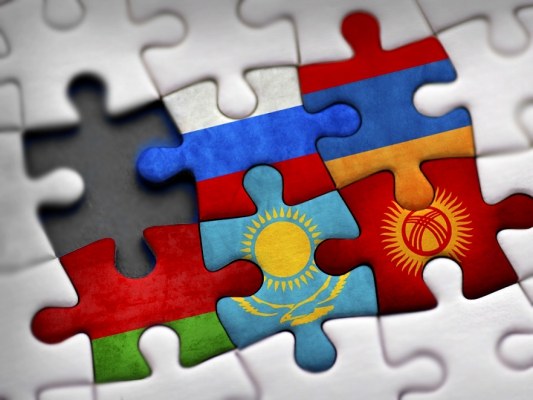
Members of the Eurasian Intergovernmental Council have presented a report on the possible consequences of suspending Armenia's membership in the Eurasian Economic Union, including information on the measures Armenia has taken to join the European Union and an analysis of the compatibility of legal regimes. The document provides details on the legal mechanisms envisaged to prevent the risks stemming from Armenia's decision to join the EU, which will also be presented to the heads of state. The document notes that the EAEU has questions regarding Armenia's status within the organization, since the introduction of European standards threatens to undermine the integrity of the EAEU customs area, and simultaneous membership is impossible from a legal and practical standpoint.
Suspending participation in the EAEU will inevitably lead to a serious deterioration in Armenia's economic indicators, as a result of which the country's total trade turnover will decline by more than 55 percent. In particular, exports to EAEU member countries will fall by more than 65 percent, while imports from those states will be cut by nearly half, which will seriously affect the economy. At the same time, gas import prices for Armenia will rise by 69 percent, reaching $657.5 million annually, and the country's GDP will respond with a 15.6 percent decline.
As a consequence of suspending membership, labor quotas will be established to ensure equivalent employment for Armenian citizens, and obtaining work permits will become a forced necessity. In addition, rail freight transportation will also become significantly more expensive, and new mechanisms for full sanitary and veterinary-sanitary control of products will be introduced. Despite all this, Russia, Belarus, Kazakhstan and Kyrgyzstan, respecting the right of the Armenian people to make an independent decision, have in turn stated that they are not interested in Armenia's withdrawal from the EAEU.
The report presented by the Eurasian Intergovernmental Council reveals the deep economic and legal contradictions that inevitably arise when trying to combine the possibilities of integrating with the EU and remaining within the EAEU. Documents of such scale show how closely the vital sectors of the Armenian economy are interconnected with existing interstate agreements.
These developments create new challenges for the country's energy security and foreign trade, especially when it comes to the sharp rise in gas prices and the decline in trade volumes. The negotiations between the parties over the coming weeks will be decisive in clarifying the future political and economic course.