




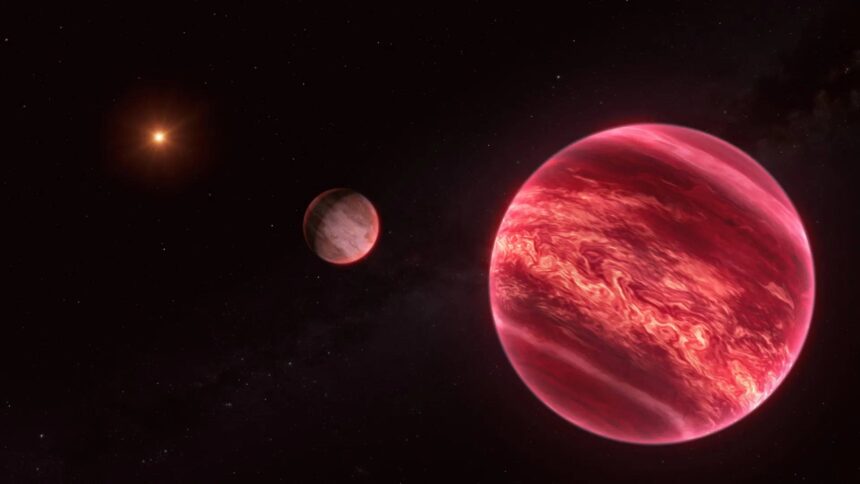
Astronomers have discovered potential traces of the first moon outside the Solar System, orbiting a sub-brown dwarf. Using powerful instruments from the European Southern Observatory, researchers studied the CD-35 2722 star system and noticed an unusual object. This large body is close in size to Jupiter, but it orbits a celestial body located between a planet and a star.
The authors of the study note that such a structure differs sharply from our Solar System, making the use of familiar terms difficult. The newly discovered exomoon is not inferior in mass to giant planets, but its orbit passes not around a star, but around a more massive companion. This circumstance forces scientists to revise the accepted principles of planet and moon classification.
The scientific world has been trying to find similar bodies for years, but to date there are no confirmed discoveries. Researchers applied the velocity change method, which allows noticing even the slightest fluctuations in the movement of celestial bodies. Giant observatories under construction in the future will provide an opportunity to study such systems in more detail and uncover the secrets of their origin.
This discovery is an important step in deepening our understanding of the universe, as it reveals hitherto unknown celestial structures. Such complex interactions of systems force scientists to revise existing theories. Upcoming observations will show how common such phenomena are in the universe.