



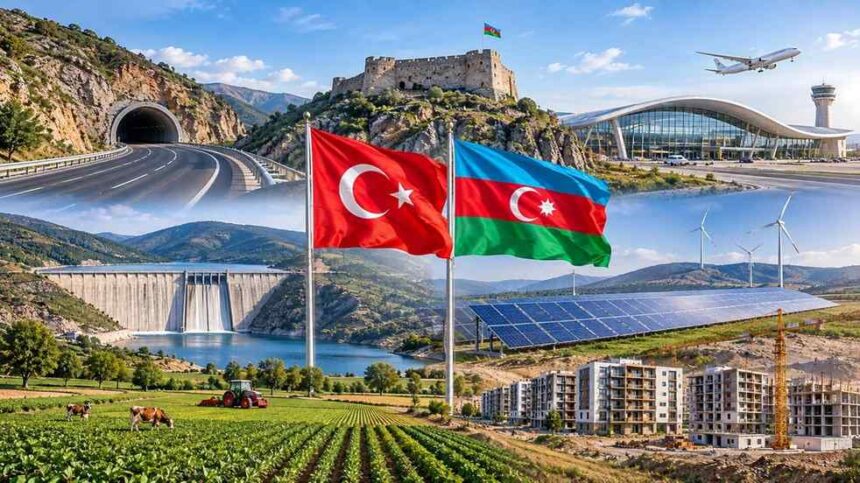
Turkish companies are implementing investment and infrastructure projects worth around $5 billion in Artsakh and the so-called "Eastern Zangezur" region. Around 20 Turkish companies are involved in activities across the region.
The companies are reportedly carrying out around 50 projects with a combined value of up to $5 billion. Meanwhile, according to the Azerbaijani Embassy in Ankara, the total number of projects involving Turkish companies stands at 111.
Turkish companies are involved in road construction, energy, agriculture and the development of other infrastructure. In particular, Cengiz İnşaat is participating in the construction of the Toghanaly-Kalbajar-Istisu highway and the 23.4-kilometer Murov Tunnel. The company has also carried out road projects along the Fuzuli-Shusha route. Twelve Turkish companies took part in the construction of Fuzuli International Airport.
In agriculture, the Dost Agropark complex in Kovsakan (Zangilan), established through joint Turkish-Azerbaijani investment, is a notable project. In the energy sector, a $28.3 million solar power plant is being built in Jrakan (Jabrayil). Plans also include the restoration and construction of five small hydropower plants in the Kalbajar and Berdzor (Lachin) districts.


According to the assessment presented, the reconstruction of Karabakh is creating new economic opportunities for Turkish companies and contributing to the expansion of trade and economic cooperation between Turkey and Azerbaijan.
The discrepancy between the figures presented warrants attention. One account refers to around 50 projects with a total estimated value of $5 billion, while another puts the number at 111. These figures do not necessarily contradict each other, as the article does not clarify whether the calculations cover the same projects, works at the same stages of implementation, or projects selected according to the same criteria.
The distribution of projects across different sectors shows that the involvement of Turkish companies is not limited to road construction. The establishment of an agricultural complex and the development of energy infrastructure are also part of this economic engagement. Any further assessment will depend on understanding not only the total volume of announced investments but also the progress of their implementation and the scale of work actually completed.