



Scientists have created four of the hundreds of thousands of new materials designed by artificial intelligence. They are metal-organic frameworks (MOFs), specially structured porous materials that could be used for carbon dioxide capture, water harvesting and hydrogen storage. The findings have been published in the journal Nature Computational Science.
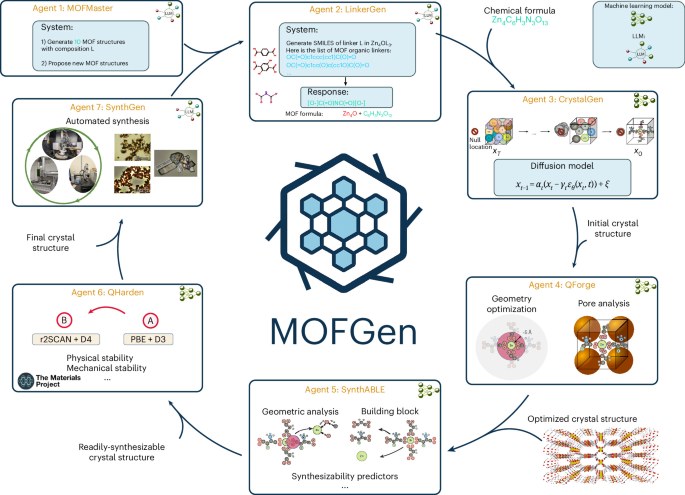
Scientists developed an AI system called MOFGen that combines several specialized tools. One proposes the chemical composition of materials, another designs their crystal structures, while others assess whether the materials are stable and can be synthesized in a laboratory. The system generated 259,559 possible structures and approximately 180,000 organic components.
Most of the designed materials underwent computer-based screening, but scientists selected 349 of the most promising candidates for laboratory experiments. Four of them were successfully synthesized. The work focused primarily on zinc-based materials.
The new materials were named AI-MOFs. One was created by combining an already known organic component with zinc. For another, scientists modified the structure of a molecule proposed by the AI system. In the case of the third and fourth materials, they tested different combinations of new components and synthesis conditions. The structures of the resulting crystals were compared with computer predictions using X-ray analysis.



The researchers note that the system still has limitations: it can design structures containing a maximum of 256 atoms, while the material synthesis process is not yet fully automated and requires the involvement of specialists.
The most interesting aspect of this work is that artificial intelligence has not simply proposed new chemical structures but has also attempted to address one of the most challenging problems in materials science: predicting which of them can actually be produced. This is precisely where the difference between computer modeling and experimental science lies. A material may be theoretically stable, but the conditions required to produce it may be extremely difficult to achieve.


At the same time, successfully synthesizing four materials does not mean that the system can independently discover and produce any new material. The researchers limited their experiments primarily to zinc-based structures, while specialists were involved in selecting the final candidates and organizing the experiments. This shows that the key challenge in the next stage will be not only the ability to generate new structures but also to accurately assess the likelihood of producing them. If these two processes can be more closely integrated, the path to discovering new materials could become significantly shorter.