



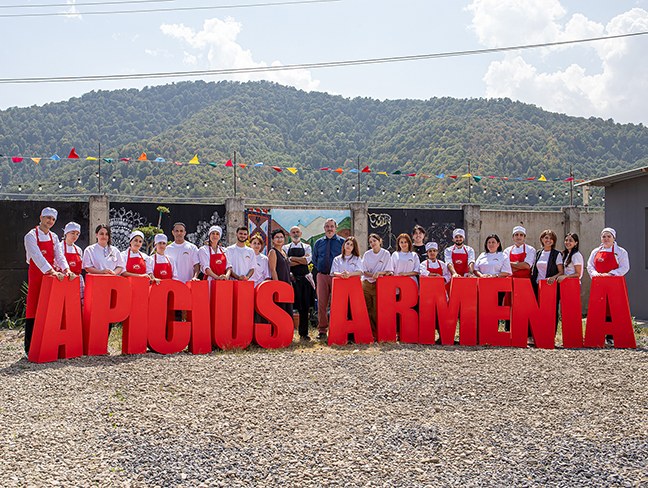
Students of Armenia's first international hospitality school have completed their initial phase of study and will soon depart for Florence to continue their education in Italy. This institution, the Apicius International School of Hospitality and Gastronomy, is a branch of the Apicius school in Florence, established in Dilijan in 2025 by the Green Rock Foundation. The educational institution offers training in two main tracks: "Food, Wine, and Healthy Lifestyle Studies" and "Hospitality Management."
Some of the first 12 students focused on culinary arts, pastry making, winemaking, healthy living, and nutrition. Another group studied hospitality and special events organization, as well as real estate, infrastructure, and spa management. After completing this two-year course in Armenia and Italy, students will have the opportunity to pursue their higher academic education in Florence in their chosen specialties.
"Many did not believe it would be possible to open such a school in Armenia, let alone in Dilijan, but today, the fact that we are sending 9 students to Italy proves otherwise. We are greatly inspired by the belief that Armenia, and especially Dilijan, has a great future as a global tourist destination," noted Katya Bredikhina, Director of the Green Rock Foundation.
The educational component of the program implemented in Armenia fully complies with the standards and curriculum of the parent school in Italy. Instruction is primarily provided by Italian specialists, with the training placing a strong emphasis on practical skills. To this end, the CEMI school-café has been opened in the center of Dilijan, where operations are managed entirely by Apicius students.


Admissions for the second group are currently underway. Special scholarships are also available to applicants with the support of the Green Rock Foundation.
The introduction of professional education meeting international standards in Dilijan is an important step toward qualitative change in the tourism and hospitality sector in Armenia. The involvement of Italian specialists and the provision of a practical environment allow for the training of competitive personnel locally.



The success of this project and the fact that students are being sent to Florence demonstrate that implementing similar educational programs in the regions is realistic. From a future development perspective, it will be essential to see how many of these specialists, having received their education abroad, return to Armenia to develop the local market.