




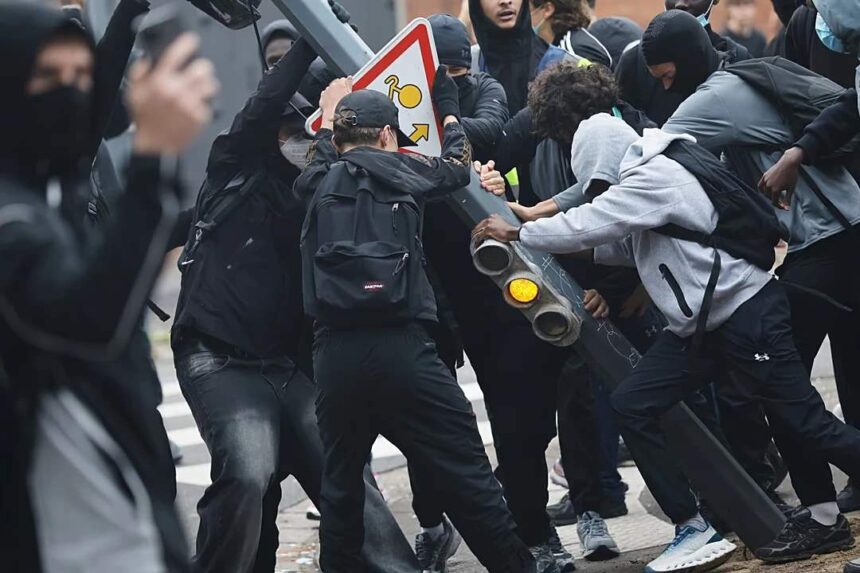
High school students across France have taken to the streets demanding significant improvements to learning conditions. Around 86,000 people took part in demonstrations held Tuesday morning, excluding figures from Paris.
This estimate was released before the scheduled start of the protest in the capital, where authorities were expecting an additional 20,000 to 40,000 participants. The demonstrations are ongoing due to severe issues within the secondary education system. Students are protesting teacher shortages, overcrowded classrooms, and old, dilapidated school buildings.
The wave of protests has been accompanied by acts of violence and clashes with law enforcement. Police used tear gas and batons in several locations to disperse demonstrators. More than 1,800 legal cases have already been opened in connection with the mass unrest.
To ensure security, authorities were forced to close hundreds of schools. Minister of Education Édouard Geffray stated that classes would be partially or completely suspended in 400 to 500 secondary schools, as safety could not be guaranteed there. According to him, 24 schools have been subjected to arson or looting since the start of the protest wave.


The demonstrations originated on September 17 at a Paris school but quickly transformed into a nationwide movement.
The dilapidated state of school facilities and the shortage of teachers are long-standing problems that eventually spiraled out of control. Such an escalation of tension highlights that delaying educational system reforms carries the risk of a serious social explosion.



It is notable that what began as an ordinary student protest so rapidly escalated into nationwide clashes. The closure of hundreds of schools and thousands of legal cases demonstrate that authorities are currently resorting to forceful and administrative measures rather than addressing the root causes.