



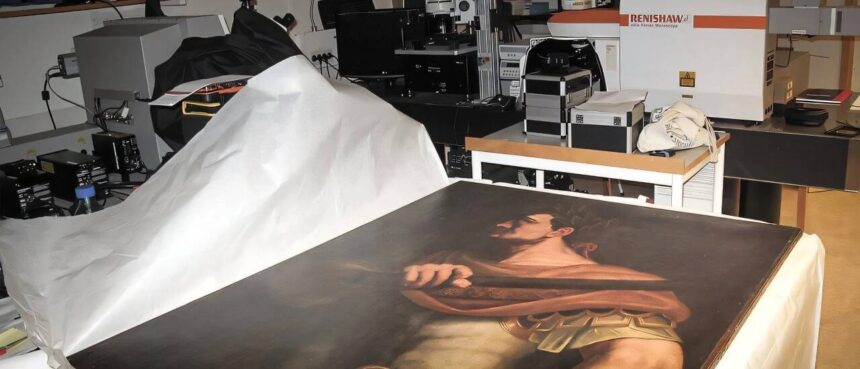
Scientists studying a historical painting signed “L daVinci” have discovered Prussian blue, a synthetic pigment whose production began only in the early 18th century. However, this fact does not necessarily mean that the entire artwork is a forgery.
Specialists from Uppsala University examined a painting depicting Roman Emperor Domitian, on which the “L daVinci” signature is poorly distinguishable and is probably followed by the Latin word pinxit, meaning “painted by” or “painted.” The painting was exhibited in London in 1928 and 1929 at a Christie’s auction, where it was attributed at the time to Italian Renaissance painter Titian.
Researchers Jakob Thour and Thomas Edvinsson used Raman spectroscopy to examine microscopic samples taken from different parts of the painting. They identified 13 pigments, 12 of which are traditional materials used during the Middle Ages and Renaissance. Even the black pigment in the signature, carbon soot, has been known since ancient times.
Prussian blue was found in two areas of the painting, and those layers could not have been created during the lifetimes of Leonardo da Vinci or Titian. At the same time, X-ray examination revealed changes in the area of Domitian’s laurel wreath, where the pigment was found: some leaves visible on the surface do not appear in the X-ray image.


Jakob Thour noted that later overpainting is common in old paintings, so the presence of a modern pigment does not necessarily mean the work is a forgery. It could have appeared as a result of restoration or later modifications.
The analysis of the materials has not yet established the identity of the painting’s author. Its provenance should be assessed on the basis of the evidence as a whole, including art-historical analysis, ownership history, and the results of other scientific studies.



The most important nuance in this story is that identifying a material and determining the authorship of a painting are not the same question. The presence of Prussian blue shows that at least the layers containing it could not have been made during the lifetimes of Leonardo or Titian, but the data presented in the study also point to the possibility that those areas were modified later.
The X-ray findings are particularly noteworthy because they revealed a difference between the painting’s current surface and deeper layers. This explains why the discovery of a single pigment, on its own, cannot resolve the question of authorship. A final assessment requires combining materials-science data with art-historical research and the work’s provenance history.