


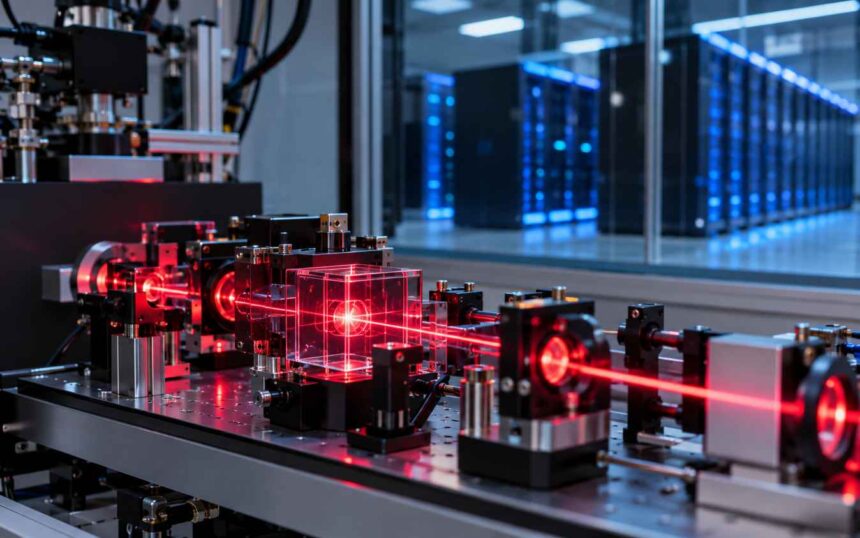
A photonic quantum computing prototype dubbed "Jiuzhang 4," developed by Chinese scientists, has been named a winner of the World Internet Conference's Leading Technology Award. The award ceremony took place on November 2 in Wuzhen, Zhejiang Province, with a total of 20 leading technology projects from around the world honored. Jiuzhang 4 became one of this year's two awardees in the field of fundamental research.
The conference's Leading Technology Award is an international science and technology prize that promotes international cooperation in the field of internet technologies. This year, more than 430 technology projects from 43 countries and regions were submitted, of which 20 were ultimately selected for awards, covering fields including quantum computing, artificial intelligence and space information.
Jiuzhang 4 marks another major advance in China's photonic quantum computing sector. On May 13 this year, a research team led by Pan Jianwei, Lu Chaoyang, Zhang Qiang and Liu Naile of the University of Science and Technology of China, joining forces with a number of the country's research institutions, built a programmable photonic quantum computing prototype with 1024 quantum compressed-state inputs and 8176 modes. The research results were published in the international scientific journal Nature.
According to the team's tests, solving a specific mathematical problem in Gaussian boson sampling requires only 25 microseconds for Jiuzhang 4 to generate a single sample. The world's fastest supercomputer, El Capitan, would need more than 10 to the 42nd power years to solve the same problem, even with the most advanced classical algorithm. By comparison, Jiuzhang 4's computing speed exceeds that of the supercomputer by a factor of 10 to the 54th power, once again setting a world record in photonic quantum computing.


Behind this result lies a trend that often remains in the shadows. This is not about a single record, but about work that has continued since 2020, when they went from 76 photons to 3050 without changing the fundamental approach. This means the team has learned to manage what had previously been considered the main obstacle: photon loss at large scales.
Another direction is also noteworthy: the superconducting "Zuchongzhi" series. Reaching the same goal with two different technologies is no coincidence; it means the country has invested in parallel in both the optical and superconducting branches, rather than focusing on just one. Such a strategy is expensive, but in this case it has proven justified.



One question remains that no one has yet clearly answered: when will these laboratory metrics turn into a tool that solves practical problems? Gaussian boson sampling is still a fairly narrow problem, and the distance from it to real application is great. But each such record shortens that path.