



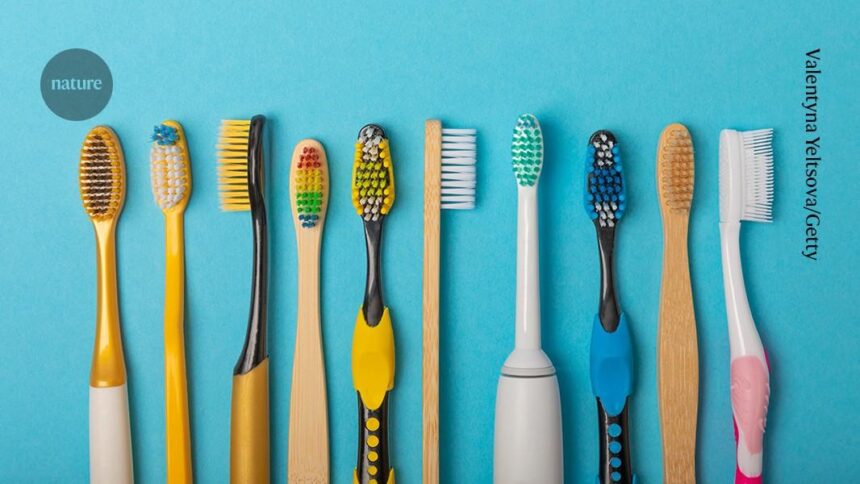
Researchers at Peking University have developed a toothbrush that needs no battery: while brushing, it generates an electric charge on its own and uses that charge to destroy bacteria, rather than relying solely on mechanical friction. The work was published in the journal Science Advances on November 4.
Frank Scannapieco, a periodontist and microbiologist at the University at Buffalo in New York, says generating electricity from brushing is "a new twist on an old idea." According to him, it could reduce dental plaque more effectively, but more testing is needed to confirm its efficacy and safety.
The researchers demonstrated that the new brush does not damage the tooth surface and is not toxic to human cells, but they did not study long-term safety or cost.
Bristle brushes, a version of which people have used to clean their teeth since the 10th century AD, rely mainly on motion, manually breaking down dental plaque, the salivary film in which bacterial communities grow.


The researchers made the bristles from polyvinylidene fluoride, a polymer that was stretched and heated to obtain its piezoelectric form, that is, a material that generates a charge when deformed.
When the teeth are brushed, the bending bristles release charges that create highly reactive oxygen species in the nearby saliva. According to the researchers, these damage bacterial cell membranes. When the bristles return to their position, the material absorbs the charges again.

The most interesting part of this development is not the idea itself but how they solved the problem: instead of a battery, the brushing motion itself was used. This means the device can operate without charging and without a power source, which is practically important for everyday use.
At the same time, the published data are still far less than what would be required to reach the market. The researchers themselves note that long-term safety and cost have not been studied, and an independent expert emphasizes the need for additional testing. This is a familiar picture for laboratory innovations: the idea is interesting, but its real usefulness has yet to be proven in clinical settings.
It is worth watching whether the research group will proceed to long-term testing and whether such a toothbrush can compete with conventional and electric brushes not only in effectiveness but also in price.