


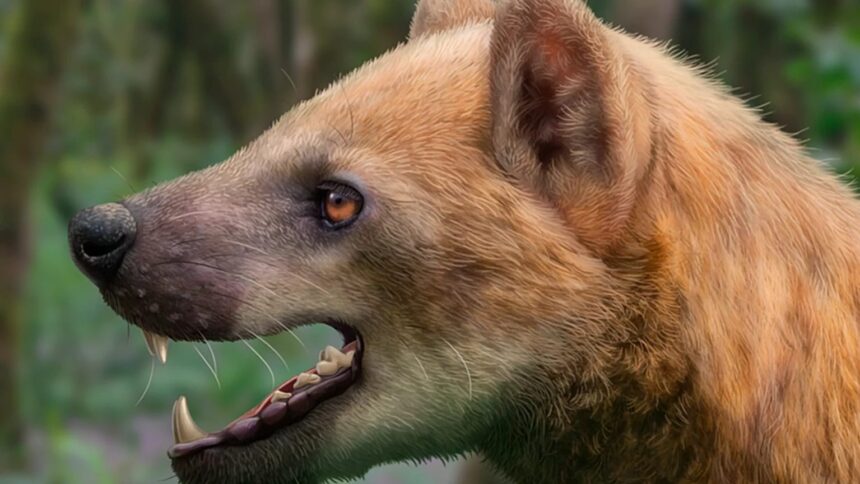
An international team of scientists has identified a new species of 'bear-dog' in Catalonia, named Paludocyon moyasolai. The skull of the species, approximately 15.9 million years old, was found in Els Casots (Barcelona) as far back as 30 years ago. An article published in the "Journal of Mammalian Evolution" expands our knowledge of Miocene-era carnivores.
The skull was discovered during excavations in Els Casots in the 1990s. At the time, researchers believed it belonged to an already known species of the Paludocyon genus, whose fragmentary remains had been found in the area. Seeing nothing new in the find, the skull was put into storage.
It was only in 2014, while preparing a doctoral thesis, that the skull was re-examined, and it was noticed that something didn't quite fit. The previously compared species was much larger, roughly the size of a lion or tiger, with a mass of about 200 kilograms.
The new find was clearly smaller. The team from the Catalan Institute of Palaeontology Miquel Crusafont dedicated the last two years to verifying this hypothesis, determining that they had an unknown species of Paludocyon before them.

The new species was named Paludocyon moyasolai in honor of paleontologist Salvador Moya-Solà.
According to researchers' estimates, this amphicyonid – a representative of an extinct group of carnivores that combined characteristics of dogs and bears – was the size of a large dog and weighed between 50 and 70 kilograms.