



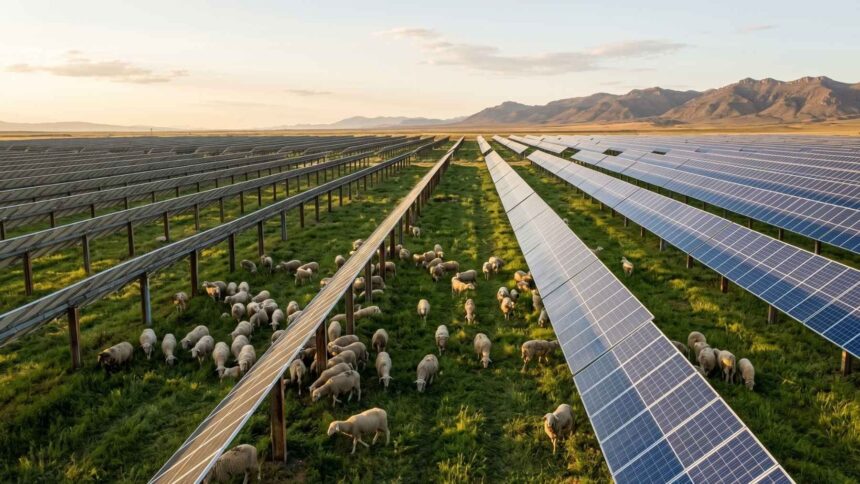
A remarkable situation has developed at the Talatan complex in the northeastern part of the Tibetan Plateau, where three years after the installation of solar panels, local herders are grazing more sheep than before the construction.
Typically, in such large-scale projects, the area is fenced off and locals are relocated elsewhere, but here everything took the opposite turn. The panels reduce wind, cool the soil, and retain moisture, as a result of which vegetation has grown so much that the company now needs sheep to trim the grass and prevent shading of the panels as well as winter fires.
Located in Gonghe County of the Hainan Tibetan Autonomous Prefecture in Qinghai Province, this huge complex is being developed by Huanghe Hydropower, a subsidiary of the State Power Investment Corporation. The complex is considered the largest solar station in the world both by area occupied and capacity: by mid-2024, its installed capacity reached around 8,430 megawatts, and by 2026, around 21 gigawatts was reported, generating over 18,000 gigawatt-hours of electricity annually. Upon completion of construction, the photovoltaic park will occupy around 609 square kilometers, with more than 7 million panels and over 60 separate operators.
Scientists have studied the Gonghe photovoltaic park, which forms part of the complex and covers about 64 square kilometers, in the most detail. Before construction, 98.5% of the area was sandy, and herders had to travel long distances to find pastures.



After the panels were installed, the reduction of direct sunlight on the soil reduced evaporation, while the water used to wash the panels dripped into the soil. In addition, the rows of panels served as windbreaks. Research showed that wind speed decreased by about 50%, soil evaporation by 30%, and vegetation cover reached 80%.
This project is a good example of how large renewable energy facilities can be combined with the local economy without depriving residents of their traditional livelihood. Engineering solutions, such as raising the panels and widening the rows, demonstrate that industrial-scale structures can be flexible.



However, considering this experience universally applicable is premature. Plant growth and soil moisturization depend heavily on regular washing of the panels, which requires a significant expenditure of water resources, especially in more arid zones.