




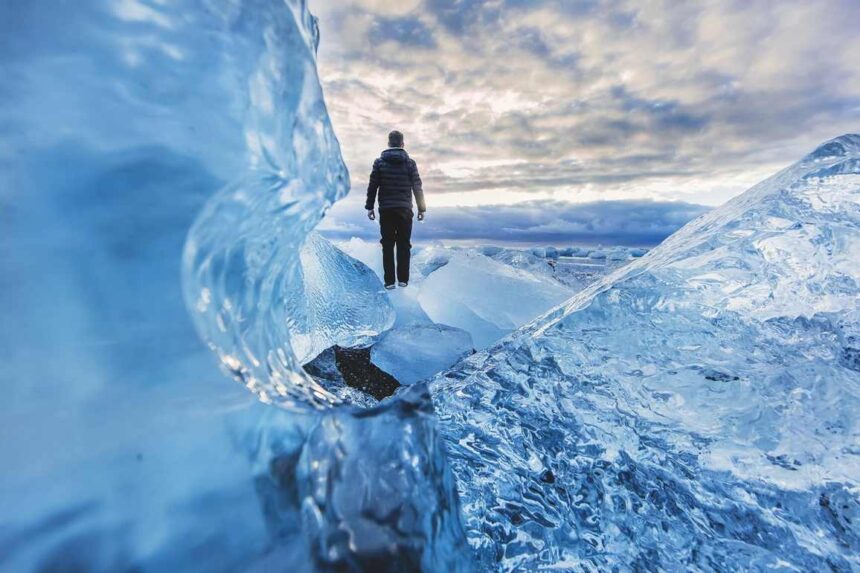
A new glacial cycle began on Earth around 2,000 years ago, but climate warming has disrupted its continuation. According to a new study, human-induced climate change could delay the next ice age by hundreds of thousands of years.
Technically, Earth is in an ice age that began about 34 million years ago, as large ice sheets persist year-round in Antarctica and Arctic Greenland. Throughout this long-lasting period, cold glacial phases alternate with warmer interglacial periods. The current warm phase began about 11,700 years ago.
North America's Laurentide Ice Sheet covered vast areas of the continent between 95,000 and 20,000 years ago, stretching from the Arctic Circle to Illinois. Most of it has since melted, leaving only the Barnes Ice Cap on Baffin Island in Canada's Nunavut territory.
Climate scientists from Columbia University and the University of Colorado studied vegetation preserved within the remaining ice cap and levels of the radioactive isotope beryllium-10 accumulated in rocks, which can help determine when the ice retreated. The results showed that the ice cap reached its minimum size about 3,000 years ago but began expanding around 2,000 years ago as the climate cooled slightly.


The ice cap was still growing as recently as 60 years ago, until rising temperatures halted the process. According to study co-author Nicholas Young, a natural process of glaciation had already begun, but human influence disrupted its course.
University of Wisconsin professor Shaun Marcott believes that human-induced climate change could delay the next ice age by hundreds of thousands of years. Moving away from fossil fuels could eventually help restore the balance of climate cycles, but the outcome remains uncertain.



According to Marcott, the course of future glacial cycles will depend on humanity's decisions and future carbon emissions. He also warns that the prolonged absence of ice ages could have a profound impact on Earth's geological history and on the biological and physical systems that evolved under glacial-cycle conditions.
The study shows that human influence on the climate is not limited to rising air temperatures or melting ice. It can also alter the long-term course of natural processes. Glacial cycles have developed over thousands of years, and changes to them could affect the environment to which many living organisms have adapted.
The precise length of the delay before the next ice age, however, will depend on future emissions and the decisions humanity makes. The study's conclusion therefore does not mean that ice ages will never return. Rather, it shows that human activity can already affect the planet's climate processes on timescales far longer than the usual planning horizons of human societies.